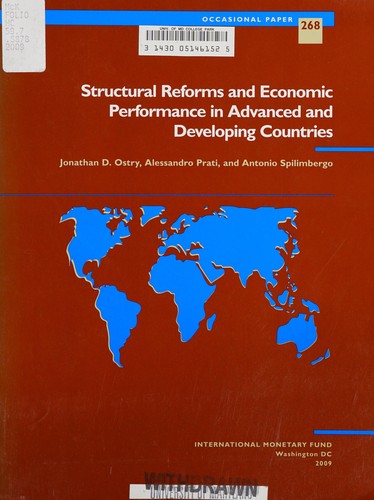
Structural Reforms and Economic Performance in Advanced and Developing Countries
0
0
As an Amazon Associate and affiliate partner, Menrva Books earns from qualifying purchases. Learn more
Author Description
This volume examines the impact on economic performance of structural policies that increase the role of market forces and competition in the economy, while maintaining appropriate regulatory frameworks. The results reflect a new dataset covering reforms of domestic product markets, international trade, the domestic financial sector, and the external capital account, in 91 developed and developing countries. Among the results of this study, the authors find that real and financial reforms (and, in particular, domestic financial liberalization, trade liberalization, and agricultural liberalization) boost income growth. However, growth effects differ significantly across alternative reform sequencing strategies: a trade-before-capital-account strategy achieves better outcomes than the reverse, or even than a "big bang"; also, liberalizing the domestic financial sector together with the external capital account is growth-enhancing, provided the economy is relatively open to international trade. Finally, relatively liberalized domestic financial sectors enhance the economy's resilience, reducing output costs from adverse terms-of-trade and interest-rate shocks; increased credit availability is one of the key mechanisms.--Publisher's description.
Menrva's Summary
THE THESIS
This volume investigates the economic consequences of structural reforms that prioritize market forces and competition within regulated frameworks. The study utilizes a novel dataset encompassing reforms in product markets, international trade, domestic finance, and the capital account across 91 countries. It finds that reforms, particularly in domestic finance, trade, and agriculture, stimulate income growth. The sequencing of these reforms significantly impacts outcomes, with a trade-before-capital-account strategy yielding superior results compared to the reverse or a
THE SCOPE MAP
- Analysis of structural reforms in domestic product markets.
- Examination of international trade liberalization policies.
- Study of domestic financial sector reforms.
- Investigation of external capital account liberalization.
- Dataset covering 91 developed and developing countries.
- Findings on the impact of reform sequencing on income growth.
- Role of domestic financial liberalization in enhancing economic resilience.
- Mechanisms through which increased credit availability affects growth and resilience.
THE AUTHORITY PERSPECTIVE
This work is a detailed empirical study analyzing the complex relationship between structural economic reforms and growth performance. It offers specific findings on the efficacy of different reform types and sequencing strategies, drawing on a comprehensive dataset. The research highlights the importance of domestic financial liberalization not only for growth but also for improving a country's ability to withstand economic shocks. The findings suggest that openness to trade is a crucial prerequisite for maximizing the benefits of financial liberalization.
Page Count:
53
Publication Date:
2009-01-01
ISBN-10:
1589068181
ISBN-13:
9781589068186
Non-Fiction
Economics
International Trade
Community Tags
Similar Books