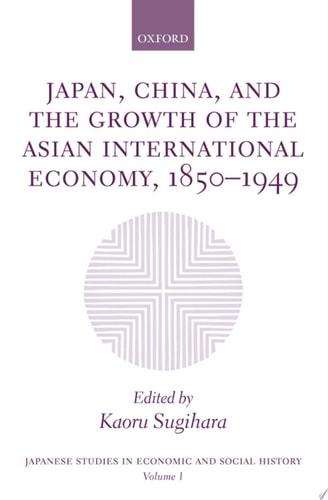
Japan, China, and the Growth of the Asian International Economy, 1850-1949
0
0
As an Amazon Associate and affiliate partner, Menrva Books earns from qualifying purchases. Learn more
Author Description
Modern Asian economic history has often been written in terms of Western impact and Asia's response to it. This volume argues that the growth of intra-regional trade, migration, and capital and money flows was a crucial factor that determined the course of East Asian economic development. Twelve chapters are organized around three main themes. First, economic interactions between Japan and China were important in shaping the pattern of regional industrialization. Neither Japan nor China imported technology and organizations, and attempted to "catch up" with the West alone. Japan's industrialization took place, taking advantage of the Chinese merchant networks in Asia, while the Chinese competition was a critical factor in the Japanese technological and organizational "upgrading" in the interwar period. Second, the pattern of China's integration into the international economy was shaped by the growth of intra-Asian trade, migration, and capital flows and remittances. While the Western impact was largely confined to the littoral region of China, intra-Asian trade was more directly connected with China's internal market. Both the fall of the imperial monetary system and the rise of economic nationalism in the early twentieth century reflected increasing contacts with the Asian international economy. Third, a study of intra-Asian trade and migration helps us understand the nature of colonialism and the international climate of imperialism. In spite of the adverse political environment, East Asian merchant and migration networks exploited economic opportunities, taking advantage of colonial institutional arrangements and even political conflicts. They made a contribution to national and regional economic development in the politically more favourable environment after the Second World War, by providing the valuable expertise and entrepreneurship they had accumulated prewar. The character of the international order of Asia, governed by Western powers, especially Britain,
Menrva's Summary
THE THESIS
This volume investigates how intra-regional trade, migration, and capital flows served as the primary drivers of East Asian economic development between 1850 and 1949, challenging the traditional narrative of Western-centric impact. Kaoru Sugihara, an expert in Japanese economic history, utilizes extensive historical data to argue that the economic integration of Japan and China was not merely a reaction to Western influence but a dynamic process of regional industrialization and merchant network expansion. The work provides a framework for understanding how these nations navigated the transition from imperial systems to modern economic nationalism.
THE SCOPE MAP
What You Will Find
- Analysis of intra-Asian trade, migration, and capital flow patterns from 1850 to 1949.
- Examination of the symbiotic relationship between Japanese industrialization and Chinese merchant networks.
- Evaluation of the impact of colonial institutional arrangements on regional economic development.
Scope Limits
- The text focuses primarily on the economic interactions between Japan and China rather than a comprehensive history of all Asian nations.
- It does not provide an exhaustive account of Western political influence outside of its intersection with regional economic trade.
THE AUTHORITY PERSPECTIVE
Scholars and historians frequently cite this work as a foundational text for understanding the complexities of pre-war Asian economic integration. Readers often note the academic density of the prose, which is tailored for researchers and students of economic history.
Page Count:
320
Publication Date:
2005-01-01
Publisher:
Oxford University Press
ISBN-10:
0191522007
ISBN-13:
9780191522000
History
Economics
Linguistics
English & College Success
Economics history
English
Economic systems
Economic History
Asian Studies
International Trade
Community Tags
Other Editions(3)

Similar Books











Reader Comments
Share Your Thoughts
No comments yet. Be the first to share your thoughts!