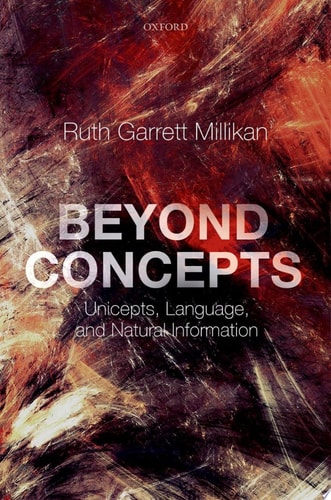
Beyond Concepts: Unicepts, Language, and Natural Information
0
0
As an Amazon Associate and affiliate partner, Menrva Books earns from qualifying purchases. Learn more
Author Description
Ruth Garrett Millikan presents a highly original account of cognition - of how we get to grips with the world in thought. The question at the heart of her book is Kant's 'How is knowledge possible?', but answered from a contemporary naturalist standpoint. The starting assumption is that we are evolved creatures that use cognition as a guide in dealing with the natural world, and that the natural world is roughly as natural science has tried to describe it. Very unlike Kant, then, we must begin with ontology, with a rough understanding of what the world is like prior to cognition, only later developing theories about the nature of cognition within that world and how it manages to reflect the rest of nature. And in trying to get from ontology to cognition we must traverse another non-Kantian domain: questions about the transmission of information both through natural signs and through purposeful signs including, especially, language.Millikan makes a number of innovations. Central to the book is her introduction of the ideas of unitrackers and unicepts, whose job is to recognize the same again as manifested through the jargon of experience. She offers a direct reference theory for common nouns and other extensional terms; a naturalist sketch of conceptual development; a theory of natural information and of language function that shows how properly functioning language carries natural information; a novel description of the semantics/pragmatics distinction; a discussion of perception as translation from natural informational signs; new descriptions of indexicals, demonstratives and intensional contexts; and a new analysis of the reference of incomplete descriptions.
Menrva's Summary
THE THESIS
How is knowledge possible for evolved creatures navigating a natural world? Ruth Garrett Millikan, a prominent philosopher of mind and language, addresses this fundamental Kantian question by grounding her inquiry in contemporary naturalism. She argues that cognition must be understood as a biological function, requiring an ontological starting point that precedes the development of conceptual frameworks, ultimately explaining how human thought and language successfully track features of the external environment.
THE SCOPE MAP
What You Will Find
- Introduction of the unitracker and unicept framework for cognitive recognition.
- A direct reference theory for common nouns and extensional terms.
- A naturalist analysis of language function and the transmission of natural information.
- Theoretical distinctions between semantics and pragmatics within a biological context.
- Re-evaluations of perception, indexicals, demonstratives, and intensional contexts.
THE AUTHORITY PERSPECTIVE
Experts in philosophy and cognitive science recognize this work as a dense, rigorous contribution to the naturalist tradition. Readers frequently note the high level of technical complexity, marking it as a significant text for those already familiar with the intersection of evolutionary biology and analytic philosophy.
Page Count:
256
Publication Date:
2017-11-28
Publisher:
Oxford University Press
ISBN-10:
0198717199
ISBN-13:
9780198717195
Philosophy
Epistemology
Mind & Body
Naturalism
Cognition
Knowledge Theory
Ontology
Community Tags
Similar Books