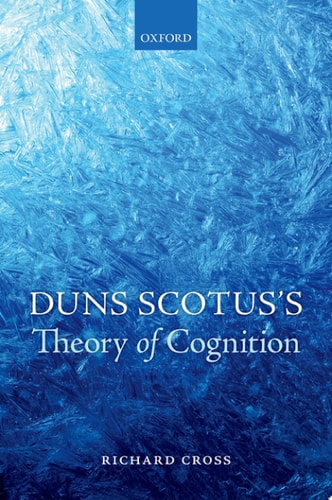
Duns Scotus's Theory of Cognition
0
0
As an Amazon Associate and affiliate partner, Menrva Books earns from qualifying purchases. Learn more
Author Description
Richard Cross provides the first complete and detailed account of Duns Scotus's theory of cognition, tracing the processes involved in cognition from sensation, through intuition and abstraction, to conceptual thought. He provides an analysis of the ontological status of the various mental items (acts and dispositions) involved in cognition, and a new account of Scotus on nature of conceptual content. Cross goes on to offer a novel, reductionist, interpretation of Scotus's view of the ontological status of representational content, as well as new accounts of Scotus's opinions on intuitive cognition, intelligible species, and the varieties of consciousness. Scotus was a perceptive but highly critical reader of his intellectual forebears, and this volume places his thought clearly within the context of thirteenth-century reflections on cognitive psychology, influenced as they were by Aristotle, Augustine, and Avicenna. As far as possible, Duns Scotus's Theory of Cognition traces developments in Scotus's thought during the ten or so highly productive years that formed the bulk of his intellectual life.
Menrva's Summary
THE THESIS
This volume investigates the complex cognitive framework of Duns Scotus by analyzing his theories on sensation, intuition, and conceptual thought. Prof. Richard Cross, a scholar of medieval philosophy, utilizes a rigorous analytical approach to examine the ontological status of mental acts and representational content within Scotus's work. By situating Scotus within the thirteenth-century intellectual climate, Cross provides a systematic reconstruction of how Scotus engaged with and departed from the theories of Aristotle, Augustine, and Avicenna.
THE SCOPE MAP
What You Will Find
- A detailed examination of the transition from sensation to abstraction.
- Analysis of the ontological status of mental items including acts and dispositions.
- A reductionist interpretation of representational content.
- Historical context regarding thirteenth-century cognitive psychology.
Scope Limits
- The text focuses primarily on the ten-year period of Scotus's most productive intellectual output.
- It does not provide a general biography of Scotus outside of his cognitive theories.
THE AUTHORITY PERSPECTIVE
Scholars and students of medieval philosophy frequently cite this work as a definitive and highly technical resource for understanding Scotus's complex psychological theories. Experts highlight the text's density and its success in clarifying the often-obscure ontological distinctions found in scholastic thought.
Page Count:
240
Publication Date:
2014-01-01
Publisher:
OUP Oxford
ISBN-10:
0191507792
ISBN-13:
9780191507793
Philosophy
Cognitive Psychology
Cognition
History & Surveys
Epistemology
Philosophy history
Community Tags
Similar Books