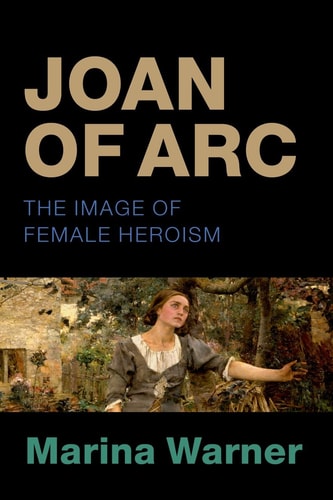
Joan of Arc: Image of Female Heroism
0
0
As an Amazon Associate and affiliate partner, Menrva Books earns from qualifying purchases. Learn more
Author Description
The fame of Joan of Arc began in her lifetime and, though it has dipped a little now and then, she has never vanished from view. Her image acts as a seismograph for the shifts and settlings of personal and political ideals: Joan of Arc is the heroine every movement has wanted as their figurehead. In France, anti-semitic, xenophobic, extreme right parties have claimed her since the Action Francaise in the 19th century. By contrast, Socialists, feminists, and liberal Catholics rallied to her as the champion of the dispossessed and the wrongly accused. Joan of Arc has also played a crucial role in changing visions of female heroism. She has proved an inexhaustible source of inspiration for writers, playwrights, film-makers, performers, and composers. In a single, brief life, several of the essential mythopoiec characteristics that throughout history have defined the charismatic leader and saint are powerfully and intensely condensed. Even while Joan of Arc was still alive, but far more so after her death, the heroic part of her story sparked narratives of all kinds, in pictures, ballads, plays, and also satires. This was only heightened in 1841-9 by the publication of the Inquisition trial which had examined Joan for witchcraft and heresy. The transcript of the interrogations gives us the voice of this young woman across the centuries with almost unbearable immediacy; her spirit leaps from the page, uncompromising in its frankness, good sense, courage, and often breathtaking in its simple effectiveness. Joan of Arc is one of the most fully and vividly present personalities in history, about whom a great more is known, in her own words and at first hand, than is, for example, about Shakespeare. However, this has not stopped the flow of fictions and fantasies about her. Marina Warner analyses the symbolism of the Maid in her own time and in her rich afterlife in popular culture. The cultural expressions are part of an ongoing historical struggle to own the symbol.
Menrva's Summary
THE THESIS
This work investigates how the historical figure of Joan of Arc has been continuously reinterpreted and utilized as a symbolic vessel for shifting political, religious, and social ideologies across centuries. Marina Warner, a noted cultural historian, examines the tension between the documented reality of Joan's life and the persistent myths constructed around her image. By analyzing primary source transcripts from the Inquisition trials alongside centuries of artistic and political appropriation, Warner argues that Joan serves as a unique seismograph for Western cultural values. The text explores how her identity has been claimed by disparate groups, ranging from extreme right-wing nationalists to feminists and socialists, to validate their own agendas.
THE SCOPE MAP
What You Will Find
- Analysis of the 15th-century Inquisition trial transcripts as a primary historical record.
- Examination of Joan of Arc's symbolic evolution in literature, film, and visual arts.
- Case studies on the appropriation of her image by 19th and 20th-century political movements.
- Exploration of the intersection between sainthood, gender, and the construction of female heroism.
THE AUTHORITY PERSPECTIVE
Scholars and critics frequently cite this text as a foundational study in the field of cultural history and the analysis of myth-making. Readers note the academic rigor of Warner's prose, which balances detailed historical documentation with insightful commentary on the fluidity of historical memory.
Page Count:
400
Publication Date:
1900-01-01
Publisher:
FisicalBook
ISBN-10:
0198718799
ISBN-13:
9780198718796
Religion
History
Biography
European History
Community Tags
Similar Books