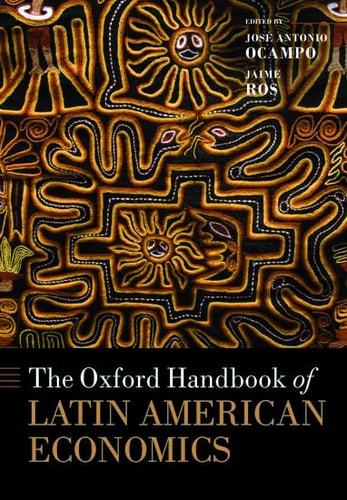
The Oxford Handbook of Latin American Economics
0
0
As an Amazon Associate and affiliate partner, Menrva Books earns from qualifying purchases. Learn more
Author Description
Latin America has been central to the main debates on development economics, ranging from the relationships between income inequality and economic growth, and the importance of geography versus institutions in development, to debates on the effects of trade, trade openness and protection on growth and income distribution. Despite increasing interest in the region there are few English language books on Latin American economics. This Handbook, organized into five parts, aims to fill this significant gap.Part I looks at long-term issues, including the institutional roots of Latin America's underdevelopment, the political economy of policy making, the rise, decline and re-emergence of alternative paradigms, and the environmental sustainability of the development pattern. Part II considers macroeconomic topics, including the management of capital account booms and busts, the evolution and performance of exchange rate regimes, the advances and challenges of monetary policies and financial development, and the major fiscal policy issues confronting the region, including a comparison of Latin American fiscal accounts with those of the OECD. Part III analyzes the region's economies in global context, particularly the role of Latin America in the world trade system and the effects of dependence on natural resources (characteristic of many countries of the region) on growth and human development. It reviews the trends of foreign direct investment, the opportunities and challenges raised by the emergence of China as buyer of the region's commodities and competitor in the world market, and the transformation of the Latin America from a region of immigration to one of massive emigration. Part IV deals with matters of productive development. At the aggregate level it analyzes issues of technological catching up and divergence as well as different perspectives on the poor productivity and growth performance of the region during recent decades. At the sectoral level, it looks at ag
Menrva's Summary
THE THESIS
This handbook investigates the complex development trajectories of Latin American economies by analyzing the interplay between historical institutions, macroeconomic policy, and global market integration. Editors Jaime Ros and José Antonio Ocampo, both established scholars in development economics, curate a collection of expert contributions that evaluate the region's long-term growth patterns. The text provides a rigorous framework for understanding why Latin American nations have faced persistent challenges in productivity and income distribution compared to other global regions.
THE SCOPE MAP
What You Will Find
- Analysis of institutional roots and the political economy of policy making in Latin America.
- Macroeconomic assessments of capital account volatility, exchange rate regimes, and fiscal policy.
- Examination of global trade dynamics, including the impact of natural resource dependence and the rise of China as a regional trade partner.
- Sectoral and aggregate studies on technological divergence and productivity performance.
THE AUTHORITY PERSPECTIVE
Experts identify this volume as a foundational reference for students and researchers seeking a comprehensive overview of the region's economic history and contemporary challenges. Readers frequently note the academic density of the prose, which serves as a primary resource for advanced study in development economics.
Page Count:
960
Publication Date:
2014-10-21
Publisher:
Oxford University Press
ISBN-10:
0198716133
ISBN-13:
9780198716136
Economics
Macroeconomics
International Trade
Community Tags
Similar Books