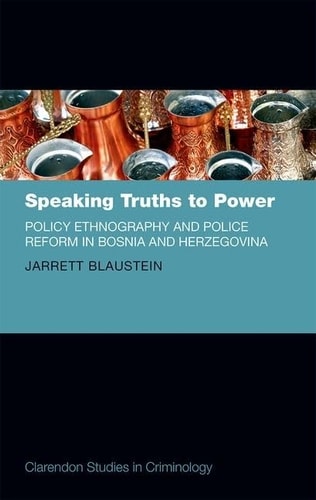
Speaking Truths to Power: Policy Ethnography and Police Reform in Bosnia and Herzegovina
0
0
As an Amazon Associate and affiliate partner, Menrva Books earns from qualifying purchases. Learn more
Author Description
Speaking Truths to Power: Policy Ethnography and Police Reform in Bosnia and Herzegovina presents a rigorous institutional-level analysis of the effects of globalisation on local policing, drawing on data generated from two ethnographic case studies conducted in 2011 in the transitional, post-conflict society of Bosnia and Herzegovina. Through a study of the structures, mentalities and practices, it situates the phenomenon of 'glocal policing' in relation to the converging development and security discourses following the collapse of the Soviet Union, and raises important questions about the purpose and value of criminological engagement with transitional policing.The idea of 'speaking truths to power' (as opposed to a single 'truth') is illustrated by the author's 2011 fieldwork, covering active police capacity building projects implemented by international organisations. Both studies indicate that global inequalities affect police reform projects, but also that nodal opportunities do exist for seemingly disempowered stakeholders, specifically international development workers and rank-and-file police officers, to exercise reflexivity and use their available power resources to mitigate structural harms, thus rendering their work responsive to the needs of policy recipients. This mediatory role is then analysed through the conceptual lens of 'policy translation', providing an innovative framework for interpreting how policy meaning and content are altered as a result of their transmission between contexts.Through detailed and persuasive investigation, Speaking Truths to Power argues that it is time for criminology to move beyond the established broad structural critiques of transnational policing power. As the author demonstrates, an institutional perspective employing ethnographic methods can ensure that the revealed criticisms adequately reflect the diverse interests, experiences and understandings of the research participants.
Menrva's Summary
THE THESIS
This book investigates how globalized policy frameworks influence local police reform in post-conflict societies, specifically questioning the efficacy of top-down institutional interventions. Jarrett Blaustein utilizes his 2011 ethnographic fieldwork in Bosnia and Herzegovina to examine the intersection of security discourse and development projects. By applying the conceptual lens of 'policy translation,' the author argues that criminological research must shift from broad structural critiques toward granular, institutional-level analysis that accounts for the agency of individual stakeholders.
THE SCOPE MAP
What You Will Find
- Analysis of two ethnographic case studies conducted in post-conflict Bosnia and Herzegovina.
- A theoretical framework for 'policy translation' and 'glocal policing' within transitional societies.
- Examination of power dynamics between international development workers and rank-and-file police officers.
- Critical assessment of how global inequalities shape the implementation of local security reforms.
THE AUTHORITY PERSPECTIVE
Experts recognize this work as a significant contribution to the field of critical criminology, particularly for its methodological focus on institutional ethnography. Readers frequently note the academic density of the prose, which serves as a foundational text for scholars interested in the intersection of international policy and local policing practices.
Page Count:
288
Publication Date:
2015-07-21
Publisher:
Oxford University Press
ISBN-10:
0198723296
ISBN-13:
9780198723295
International relations
Criminology
Policy Studies
Police Power
Sociology
Crime europe
Ethnography
Police
Community Tags
Similar Books