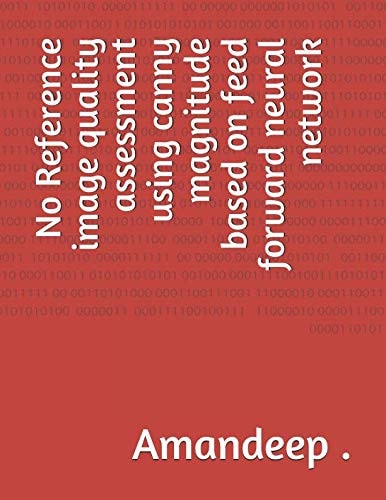
No Reference Image Quality Assessment Using Canny Magnitude Based on Feed Forward Neural Network
0
0
As an Amazon Associate and affiliate partner, Menrva Books earns from qualifying purchases. Learn more
Author Description
With an increase in the popularity of smartphones, compact cameras, and Internet services like Facebook and Instagram, past few years have seen incredible development in the creation and sharing of digital images. The way of a digital image starts with it being acquired by a digital camera, which converts it into a digital format and compresses it using lossy compression algorithms to meet the involved storage availability.This image is then transmitted over wired or wireless transmission channels and is changed in its motion to gather the obtainable bandwidth. Finally, the end user receives this image and watches it over devices ranging from smartphones to 4K displays,which require further changes to its resolution
Menrva's Summary
THE THESIS
This work investigates a novel approach to assessing digital image quality without relying on a pristine reference image. The proliferation of digital images, driven by smartphones and social media, necessitates efficient quality assessment methods. This book details a system that utilizes the Canny edge detector's magnitude to extract features, which are then fed into a feed-forward neural network for quality prediction. The research addresses the challenges posed by image acquisition, compression, transmission, and display variations.
THE SCOPE MAP
- Utilizes Canny edge detector magnitude for feature extraction.
- Employs a feed-forward neural network for image quality assessment.
- Addresses the challenges of digital image processing pipelines.
- Focuses on no-reference image quality assessment (NR-IQA).
- Explores the impact of compression and transmission on image quality.
- Discusses image display variations and their effect on perceived quality.
THE AUTHORITY PERSPECTIVE
The research presented in this book offers a technical contribution to the field of image quality assessment. By focusing on a no-reference approach using neural networks and Canny edge features, it targets a specific problem within digital image processing. The detailed methodology suggests a potentially valuable tool for applications where reference images are unavailable. The work is likely to be of interest to researchers and practitioners in computer vision and machine learning.
Page Count:
47
Publication Date:
2017-08-07
Publisher:
Independently Published
ISBN-10:
1723797472
ISBN-13:
9781723797477
Science
Image Processing
Machine Learning
Computer Vision
Community Tags
Similar Books