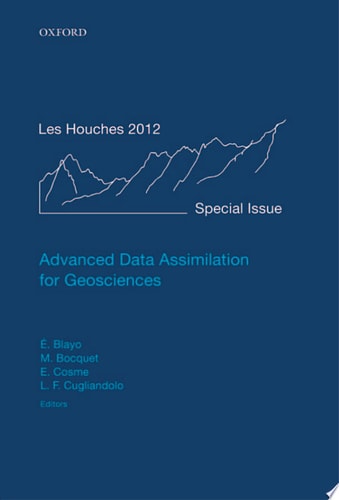
Advanced Data Assimilation for Geosciences: Lecture Notes of the Les Houches School of Physics
0
0
As an Amazon Associate and affiliate partner, Menrva Books earns from qualifying purchases. Learn more
Author Description
Data assimilation aims at determining as accurately as possible the state of a dynamical system by combining heterogeneous sources of information in an optimal way. Generally speaking, the mathematical methods of data assimilation describe algorithms for forming optimal combinations of observations of a system, a numerical model that describes its evolution, and appropriate prior information. Data assimilation has a long history of application to high-dimensional geophysical systems dating back to the 1960s, with application to the estimation of initial conditions for weather forecasts. It has become a major component of numerical forecasting systems in geophysics, and an intensive field of research, with numerous additional applications in oceanography, atmospheric chemistry, and extensions to other geophysical sciences. The physical complexity and the high dimensionality of geophysical systems have led the community of geophysics to make significant contributions to the fundamental theory of data assimilation.This book gathers notes from lectures and seminars given by internationally recognized scientists during a three-week school held in the Les Houches School of physics in 2012, on theoretical and applied data assimilation. It is composed of (i) a series of main lectures, presenting the fundamentals of the most commonly used methods, and the information theory background required to understand and evaluate the role of observations; (ii) a series of specialized lectures, addressing various aspects of data assimilation in detail, from the most recent developments of the theory to the specificities of various thematic applications.
Menrva's Summary
THE THESIS
This volume investigates the mathematical and theoretical frameworks required to optimize the estimation of dynamical systems by integrating heterogeneous observational data with numerical models. The authors, a collective of internationally recognized experts in geophysical sciences, synthesize lecture notes from the 2012 Les Houches School of Physics to provide a rigorous pedagogical foundation. The text bridges the gap between fundamental statistical theory and the high-dimensional practical applications necessary for modern weather forecasting and oceanographic modeling.
THE SCOPE MAP
What You Will Find
- Mathematical foundations of data assimilation algorithms and information theory.
- Analysis of high-dimensional geophysical systems and their evolution models.
- Specialized lectures covering recent theoretical developments and thematic applications.
- Methodologies for combining prior information with real-time observational data.
THE AUTHORITY PERSPECTIVE
Experts recognize this collection as a foundational resource for researchers and graduate students specializing in geophysical fluid dynamics and numerical forecasting. Readers frequently note the high level of academic density, which requires a strong background in mathematics and physics to fully utilize the presented methodologies.
Page Count:
576
Publication Date:
2014-12-30
Publisher:
Oxford University Press
ISBN-10:
0198723849
ISBN-13:
9780198723844
Science
Oceanography
Mathematics
Geophysics
Meteorology
Data Analysis
Community Tags
Similar Books