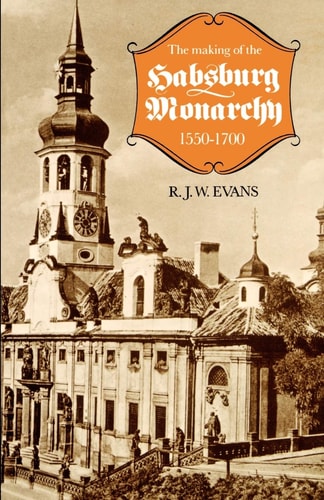
The Making of the Habsburg Monarchy, 1550-1700: An Interpretation
0
0
As an Amazon Associate and affiliate partner, Menrva Books earns from qualifying purchases. Learn more
Author Description
This book examines and accounts for the emergence of a powerful Habsburg state in central Europe during the 16th and 17th centuries. Charting the transformation of the Habsburg lands from a casual juxtaposition of territories into a major and reasonably stable commonwealth, Evans examines the social and economic changes brought about by the Counter-Reformation, the interaction between regions and central government, and the intellectual evolution from the Renaissance to the Baroque.
Menrva's Summary
THE THESIS
This work investigates the mechanisms and socio-political processes that facilitated the consolidation of the Habsburg territories into a cohesive, centralized state between 1550 and 1700. Robert John Weston Evans, a distinguished historian of Central Europe, utilizes a multidisciplinary approach to analyze how disparate lands evolved into a stable commonwealth. By synthesizing administrative records, cultural shifts, and economic data, he argues that the Counter-Reformation and the transition from Renaissance to Baroque intellectual frameworks were the primary catalysts for this political transformation.
THE SCOPE MAP
What You Will Find
- Analysis of the administrative integration of the Habsburg lands in Central Europe.
- Examination of the socio-economic impacts of the Counter-Reformation on regional governance.
- Exploration of the intellectual transition from Renaissance humanism to Baroque culture.
- Assessment of the power dynamics between regional estates and the central Habsburg government.
THE AUTHORITY PERSPECTIVE
Historians frequently cite this work as a foundational text for understanding the structural evolution of the Habsburg Monarchy in the early modern period. Scholars often highlight the author's ability to integrate cultural and intellectual history with traditional political analysis, making it a standard reference for the field.
Page Count:
556
Publication Date:
1984-03-22
Publisher:
Oxford University Press
ISBN-10:
0198730853
ISBN-13:
9780198730859
History
Political History
Social History
European History
Community Tags
Similar Books