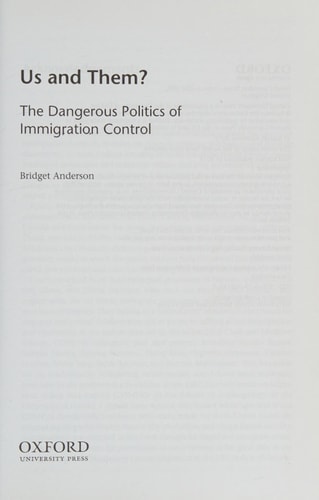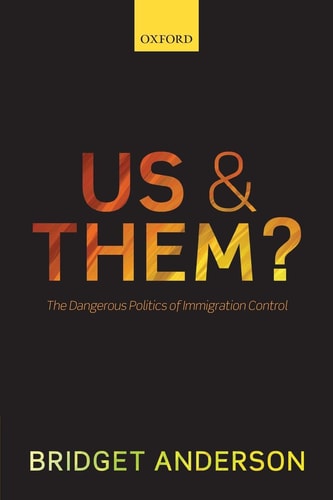
Us and Them: The Dangerous Politics of Immigration Controls
0
0
As an Amazon Associate and affiliate partner, Menrva Books earns from qualifying purchases. Learn more
Author Description
Us and Them? explores the distinction between migrant and citizen through using the concept of 'the community of value'. The community of value is comprised of Good Citizens and is defined from outside by the Non-Citizen and from the inside by the Failed Citizen, that is figures like the benefit scrounger, the criminal, the teenage mother etc. While Failed Citizens and Non-Citizens are often strongly differentiated, the book argues that it is analytically and politically productive to consider them together. Judgments about who counts as skilled, what is a good marriage, who is suitable for citizenship, and what sort of enforcement is acceptable against 'illegals', affect citizens as well as migrants. Rather than simple competitors for the privileges of membership, citizens and migrants define each other through sets of relations that shift and are not straightforward binaries. The first two chapters on vagrancy and on Empire historicise migration management by linking it to attempts to control the mobility of the poor. The following three chapters map and interrogate the concept of the 'national labour market' and UK immigration and citizenship policies examining how they work within public debate to produce 'us and them'. Chapters 6 and 7 go on to discuss the challenges posed by enforcement and deportation, and the attempt to make this compatible with liberalism through anti-trafficking policies. It ends with a case study of domestic labour as exemplifying the ways in which all the issues outlined above come together in the lives of migrants and their employers.
Menrva's Summary
THE THESIS
This book investigates the political and social construction of the 'community of value' to explain how immigration controls define the boundaries of citizenship. Bridget Anderson, a professor of migration and citizenship, utilizes historical analysis and policy critique to argue that the distinction between citizens and migrants is not a simple binary, but a complex relationship that also marginalizes certain groups within the domestic population. By examining how states categorize individuals as 'Good Citizens' versus 'Failed Citizens' or 'Non-Citizens,' the author reveals how immigration enforcement mechanisms impact the rights and status of all members of society.
THE SCOPE MAP
What You Will Find
- Historical analysis of vagrancy laws and the legacy of Empire in modern migration management.
- A conceptual framework defining the 'community of value' and its internal and external boundaries.
- Critical interrogation of the 'national labour market' and its role in shaping UK immigration policy.
- Case study analysis of domestic labor as a nexus for issues regarding enforcement, deportation, and liberalism.
THE AUTHORITY PERSPECTIVE
Scholars and sociologists frequently cite this work as a foundational text for understanding the intersection of migration policy and domestic social control. Readers often note the academic rigor of the prose, which provides a sophisticated critique of how state power creates hierarchies of belonging.
Page Count:
224
Publication Date:
2015-07-28
Publisher:
Oxford University Press
ISBN-10:
0198737610
ISBN-13:
9780198737612
Sociology
Communities
Labor Studies
Public Policy
Immigration
Citizenship
Immigrants
Community Tags
Similar Books