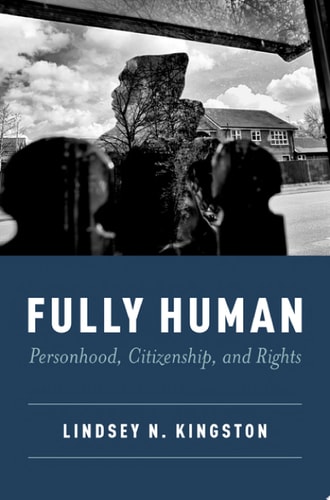
Fully Human: Personhood, Citizenship, and Rights
0
0
As an Amazon Associate and affiliate partner, Menrva Books earns from qualifying purchases. Learn more
Author Description
Citizenship within our current international system signifies being fully human, or being worthy of fundamental human rights. For some vulnerable groups, however, this form of political membership is limited or missing entirely, and they face human rights challenges despite a prevalence of international human rights law. These protection gaps are central to hierarchies of personhood, or inequalities that render some people more "worthy" than others for protections and political membership.As a remedy, Lindsey N. Kingston proposes the ideal of "functioning citizenship," which requires an active and mutually-beneficial relationship between the state and the individual and necessitates the opening of political space for those who cannot be neatly categorized. It signifies membership in a political community, in which citizens support their government while enjoying the protections and services associated with their privileged legal status. At the same time, an inclusive understanding of functioning citizenship also acknowledges that political membership cannot always be limited by the borders of the state or proven with a passport. Fully Human builds its theory by looking at several hierarchies of personhood, from the stateless to the forcibly displaced, migrants, nomadic peoples, indigenous nations, and "second class" citizens in the United States. It challenges the binary between citizen and noncitizen, arguing that rights are routinely violated in the space between the two. By recognizing these realities, we uncover limitations built into our current international system--but also begin to envision a path toward the realization of human rights norms founded on universality and inalienability. The ideal of functioning citizenship acknowledges the persistent power of the state, yet it does not rely solely on traditional conceptions of citizenship that have proven too flawed and limited for securing true rights protection.
Menrva's Summary
THE THESIS
How can the international system reconcile the gap between formal citizenship and the universal protection of human rights for vulnerable populations? Lindsey N. Kingston, a scholar of human rights and political membership, examines the inherent flaws in current legal frameworks that tie personhood to state-sanctioned citizenship. She argues that the binary distinction between citizen and noncitizen creates protection gaps that leave marginalized groups vulnerable. To address this, she introduces the concept of "functioning citizenship," a framework that prioritizes active, reciprocal relationships between states and individuals over traditional, passport-based definitions of belonging.
THE SCOPE MAP
What You Will Find
- Analysis of hierarchies of personhood and their impact on legal protections.
- A theoretical framework for "functioning citizenship" as a remedy for statelessness.
- Case studies involving indigenous nations, nomadic peoples, and forcibly displaced populations.
Scope Limits
- The text does not provide a comprehensive legal manual for individual asylum claims.
- It does not offer a detailed historical account of the evolution of the nation-state beyond its relevance to current rights discourse.
THE AUTHORITY PERSPECTIVE
Scholars in political science and human rights law identify this work as a critical intervention in the debate over the limitations of state-centric rights. Readers frequently note the academic density of the prose, which is well-suited for graduate-level study and policy analysis.
Page Count:
312
Publication Date:
2019-04-03
Publisher:
Oxford University Press
ISBN-10:
0190918268
ISBN-13:
9780190918262
Professional Career & Trade
Sociology
Human rights
Citizenship Studies
International relations
Citizenship
Immigrants
Community Tags
Similar Books