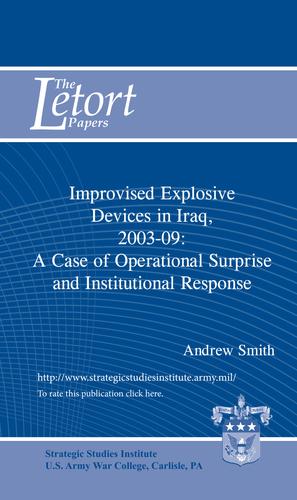
Improvised Explosive Devices in Iraq
0
0
As an Amazon Associate and affiliate partner, Menrva Books earns from qualifying purchases. Learn more
Author Description
Surprise is a familiar term in military writings and is enshrined in most nations’ doctrine. Surprises that emerge in tactics, however, can also operate at the strategic and operational levels and are particularly dangerous because they can test the relevance and adaptability of military forces and the "institutional" defense establishments that create, develop, and sustain them. A military establishment that is too slow to recognize and respond to such surprises places its nation’s interests at grave risk. Western nations are contemplating major reductions in defense spending, with consequent limitations on force structure. As the range of enemy capabilities that a force will be able to match, qualitatively and quantitatively, becomes smaller, the potential for operational and strategic surprise will increase. A key conclusion from this analysis is the critical role of strategic leadership in recognizing the scale of surprise and in forcing the necessary institutional response. At a time when budgets will not allow surprise to be addressed by maintaining large and technically diverse forces at high readiness, the ability to recognize and respond adroitly to operational and strategic surprise may be a critical requirement for a modern defense establishment.
Menrva's Summary
THE THESIS
The book investigates the strategic and operational implications of surprise tactics, particularly focusing on Improvised Explosive Devices (IEDs) in Iraq. It examines how unexpected tactical developments can challenge military forces and defense establishments, posing significant risks to national interests when responses are slow. The analysis highlights the critical role of strategic leadership in recognizing and adapting to such surprises, especially in an era of potential defense budget reductions. The ability to respond adeptly to operational and strategic surprise is presented as a key requirement for modern defense establishments.
THE SCOPE MAP
- Analysis of surprise as a military tactic at strategic, operational, and tactical levels.
- Case study focus on Improvised Explosive Devices (IEDs) in the context of the Iraq conflict.
- Examination of the adaptability and relevance of military forces and defense institutions.
- Discussion on the risks associated with slow recognition and response to enemy capabilities.
- Exploration of the critical role of strategic leadership in institutional response.
- Consideration of defense budget limitations and their impact on readiness and response to surprise.
THE AUTHORITY PERSPECTIVE
The book's analysis of surprise tactics and their impact on military institutions, particularly in the context of IEDs in Iraq, suggests a focus on strategic and operational challenges. The author's emphasis on leadership and institutional response points to a work intended for defense professionals and policymakers. The framing indicates a critical examination of how modern defense establishments must adapt to evolving threats in resource-constrained environments.
Page Count:
84
Publication Date:
2011-01-01
ISBN-10:
1584874880
Non-Fiction
History
Counter Terrorism
Geopolitics
Military History
Community Tags
Similar Books