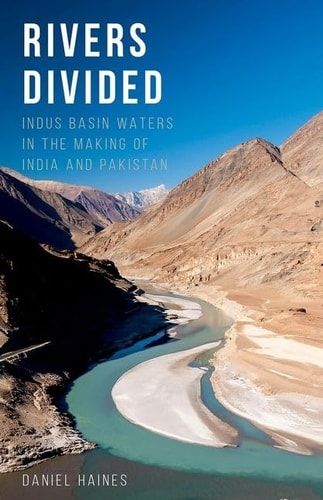
Rivers Divided: Indus Basin Waters in the Making of India and Pakistan
0
0
As an Amazon Associate and affiliate partner, Menrva Books earns from qualifying purchases. Learn more
Author Description
The Indus Waters Treaty is considered a key example of India-Pakistan cooperation, but less has been said about its critical influence on state-making in both countries. Rivers Divided reveals the importance of the Indus Basin river system, and thus control over it, for Indian and Pakistani claims to sovereignty after South Asia's Partition in 1947. Securing water flows was a key aim for both governments. In 1960 the Indus Waters Treaty ostensibly settled the dispute, but in fact failed to address critical sources of tension. Examples include the role of water in the Kashmir conflict and the riverine geography of Punjab's militarised border zone. Despite the recent resurgence of disputes over water-sharing in South Asia, the historical causes and consequences of the region's flagship natural resources treaty remain little understood. Based on new research in South Asia, the United States and United Kingdom, this book places the Indus dispute, for the first time, in the context of decolonisation and Cold War-era development politics. It examines the discord at local, national and international levels, arguing that we can only explain its importance and longevity in light of India and Pakistan's state-building initiatives after independence.
Menrva's Summary
THE THESIS
This book investigates how the control of the Indus Basin river system served as a fundamental instrument for state-building and sovereignty in India and Pakistan following the 1947 Partition. Daniel Haines, a historian specializing in South Asian environmental and political history, utilizes archival research from India, Pakistan, the United States, and the United Kingdom to reconstruct the dispute. He argues that the Indus Waters Treaty was not merely a technical agreement but a political maneuver deeply embedded in the processes of decolonization and Cold War development strategies.
THE SCOPE MAP
What You Will Find
- Historical analysis of the Indus Basin river system post-1947.
- Examination of the intersection between water management and national sovereignty.
- Contextualization of the Indus Waters Treaty within Cold War-era development politics.
- Investigation of local, national, and international levels of discord.
Scope Limits
- The text does not provide a comprehensive technical manual on modern hydraulic engineering.
- It does not offer a predictive model for future water-sharing agreements between the two nations.
THE AUTHORITY PERSPECTIVE
Scholars and historians recognize this work as a significant contribution to the understanding of South Asian state-making and environmental diplomacy. Readers frequently note the academic rigor and the depth of archival research, which provides a necessary historical foundation for current debates regarding regional water security.
Page Count:
272
Publication Date:
2017-03-01
Publisher:
Oxford University Press
ISBN-10:
019064866X
ISBN-13:
9780190648664
History
Asian Studies
Rivers
Environmental History
Geopolitics
Natural history
International relations
Community Tags
Similar Books