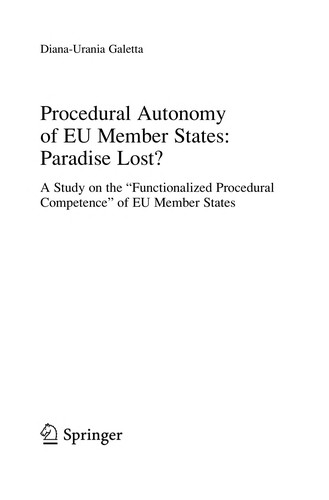
Procedural Autonomy of EU Member States: Paradise Lost?
0
0
As an Amazon Associate and affiliate partner, Menrva Books earns from qualifying purchases. Learn more
Author Description
Is the procedural autonomy of EU Member State a myth or a reality? What should this concept be taken to mean? -- Starting from the analysis of requirements and principles regulating, generally speaking, the relationships between Member States' and EU law, this book provides a definition of procedural autonomy able to account for the concept's inherent limits. -- Out of an analysis of the more relevant EU jurisprudence, the author identifies the rationale underlying the interventions of the ECJ on issues of procedural autonomy and the common logic that emerges from it; and reveals how, in an unchanged context of `procedural autonomy' of the Member States, national procedural law becomes more and more `functionalized' to the requirements of effectiveness of substantive EU law. As such, we should speak of a `functionalized procedural competence' rather than of procedural autonomy. But this is by no means a case of "Paradise Lost." -- The book includes a foreword by Prof. Jurgen Schwarze, one of the founding fathers of European Administrative Law. --Book Jacket.
Menrva's Summary
THE THESIS
This book investigates the extent to which EU Member States retain genuine procedural autonomy in their legal systems, or if this autonomy has been significantly curtailed by EU law. The author, Diana-Urania Galetta, begins by examining the foundational principles governing the interplay between Member State law and EU law to establish a nuanced definition of procedural autonomy that acknowledges its inherent limitations. Through an analysis of key European Court of Justice jurisprudence, the book identifies the Court's rationale for intervening in matters of procedural autonomy and reveals a prevailing logic where national procedural law increasingly serves the effectiveness of substantive EU law. This leads to the argument that the concept should perhaps be understood as 'functionalized procedural competence' rather than true autonomy, though the author asserts this does not signify a loss of all control.
THE SCOPE MAP
- Analysis of requirements and principles governing relationships between Member State and EU law.
- Definition of procedural autonomy that accounts for inherent limits.
- Examination of relevant EU jurisprudence and ECJ interventions.
- Identification of the common logic emerging from ECJ decisions on procedural autonomy.
- Argument for 'functionalized procedural competence' over procedural autonomy.
- Discussion of how national procedural law serves the effectiveness of substantive EU law.
- Foreword by Prof. Jurgen Schwarze, a key figure in European Administrative Law.
THE AUTHORITY PERSPECTIVE
The book is presented as a rigorous legal analysis that questions the traditional understanding of procedural autonomy within the European Union. It aims to provide a precise definition of the concept while critically examining the role of the European Court of Justice in shaping national procedural law. The author's argument suggests a shift towards a 'functionalized procedural competence,' indicating that while autonomy may be constrained, it does not represent a complete loss of control for Member States. The inclusion of a foreword by a prominent scholar in European Administrative Law signals the book's academic weight and its contribution to the field.
Page Count:
145
Publication Date:
2010-01-01
ISBN-10:
3642125468
ISBN-13:
9783642125461
Politics
History
Non-Fiction
Law
Legal Theory
Comparative Law
Community Tags
Similar Books