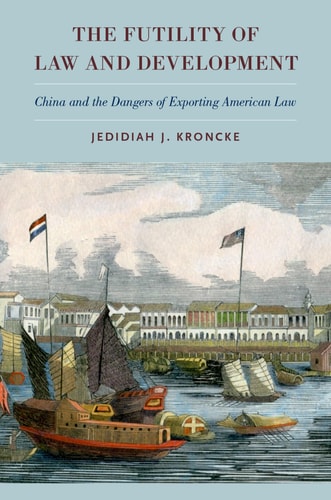
The Futility of Law and Development: China and the Dangers of Exporting American Law
0
0
As an Amazon Associate and affiliate partner, Menrva Books earns from qualifying purchases. Learn more
Author Description
For all the attention paid to the Founder Fathers in contemporary American debates, it has almost been wholly forgotten how deeply they embraced an ambitious and intellectually profound valuation of foreign legal experience. Jedidiah Kroncke uses the Founders' serious engagement with, and often admiration for, Chinese law in the Revolutionary era to begin his history of how America lost this Founding commitment to legal cosmopolitanism and developed a contemporary legal culture both parochial in its resistance to engaging foreign legal experience and universalist in its messianic desire to export American law abroad. Kroncke reveals how the under-appreciated, but central role of Sino-American relations in this decline over two centuries, significantly reshaped in the early 20th century as American lawyer-missionaries helped inspire the first modern projects of American humanitarian internationalism through legal development. Often forgotten today after the rise of the Chinese Communist Party in 1949, the Sino-American relationship in the early 20th century was a key crucible for articulating this vision as Americans first imagined waves of Americanization abroad in the wake of China's 1911 Republican revolution.Drawing in historical threads from religious, legal and foreign policy work, the book demonstrates how American comparative law ultimately became a marginalized practice in this process. The marginalization belies its central place in earlier eras of American political and legal reform. In doing so, the book reveals how the cosmopolitan dynamism so prevalent at the Founding is a lost virtue that today comprises a serious challenge to American legal culture and its capacity for legal innovation in the face of an increasingly competitive and multi-polar 21st century. Once again, America's relationship with China presents a critical opportunity to recapture this lost virtue and stimulate the searching cosmopolitanism that helped forge the original foundations of
Menrva's Summary
THE THESIS
This book investigates the historical shift in American legal culture from a tradition of cosmopolitan engagement with foreign legal systems to a parochial, messianic impulse to export American law abroad. Jedidiah Kroncke, a scholar of law and international relations, utilizes historical analysis to trace this transformation over two centuries. He argues that the decline of legal cosmopolitanism, particularly in the context of Sino-American relations, has hindered American capacity for legal innovation in a modern, multi-polar world.
THE SCOPE MAP
What You Will Find
- A historical examination of the Founding Fathers' engagement with Chinese law.
- An analysis of early 20th-century American lawyer-missionaries and their role in humanitarian internationalism.
- A critique of the American tendency toward legal universalism following the 1911 Chinese Republican revolution.
Scope Limits
- The text does not provide a comprehensive manual for modern legal reform or international development policy.
- It focuses primarily on the intellectual history of American legal culture rather than contemporary Chinese domestic law.
THE AUTHORITY PERSPECTIVE
Legal scholars and historians frequently note the book's dense, interdisciplinary approach to comparative law and foreign policy. Experts highlight this work as a significant contribution to understanding the intellectual origins of American international legal development projects.
Page Count:
374
Publication Date:
2016-01-18
Publisher:
Oxford University Press
ISBN-10:
0190233524
ISBN-13:
9780190233525
History
Law Reform
China Studies
International relations
Professional Career & Trade
Law
Comparative Law
United States
Technical Assistance
Community Tags
Similar Books