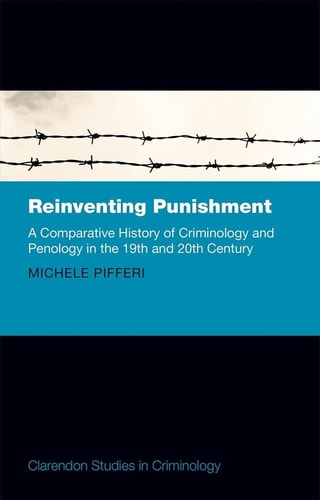
Reinventing Punishment: A Comparative History of Criminology and Penology in the 19th and 20th Century
0
0
As an Amazon Associate and affiliate partner, Menrva Books earns from qualifying purchases. Learn more
Author Description
Providing a historical analysis of the impact of criminology on the rationale of punishment and the sentencing systems in Europe and the US between the 1870s and the 1930s, Reinventing Punishment: A Comparative History of Criminology and Penology in the 19th and 20th Century investigates and contrasts the rise of the principles of individualisation of punishment, social defence, preventive justice, and indeterminate sentencing.The manner in which American and European jurisprudence enforced these ideas resulted in the emergence of two different penological identities: the American penal reform movement led to the adoption of the indeterminate sentence system, whereas the European criminological approach resulted in the formulation of the dual track system with punishment and measures of security. This theoretical divide, discussed at many international congresses and in studies of comparative criminal law, not only reflects two different ideas on the legitimacy and purpose of punishment, but also corresponds to two different constitutional views of criminal law. The book considers the relation between constitutional frameworks (rule of law and Rechtsstaat) and penological claims, explaining how some of the tenets of penal liberalism (such as principle of legality and separation of powers) were affected by penal modernism, even with the rise of authoritarian regimes. It examines the dilemmas provoked by criminology focusing on the role of the judge in the execution of sentences, the distribution of sentencing powers among judicial and administrative bodies, the balance between social security and individual guarantees, and the inconsistencies of preventive detention.Filling a notable gap in Anglo-American literature by providing a sophisticated panoramic analysis of the development of criminology in late nineteenth and first half of the twentieth century Europe, Reinventing Punishment will be of interest to scholars of criminology, criminal law, and criminal justice
Menrva's Summary
THE THESIS
This work investigates how the rise of criminology between the 1870s and 1930s fundamentally altered the rationale of punishment and sentencing systems across Europe and the United States. Michele Pifferi, a scholar in the field of legal history, utilizes a comparative analysis of jurisprudence and international congress records to examine the divergence between American indeterminate sentencing and the European dual-track system. The text argues that these penological shifts were not merely technical adjustments but reflected deeper constitutional conflicts between penal liberalism and the emerging modernist focus on social defense and preventive justice.
THE SCOPE MAP
What You Will Find
- Comparative analysis of American and European penal reform movements from the 1870s to the 1930s.
- Examination of the tension between constitutional frameworks like the rule of law and the rise of penal modernism.
- Evaluation of the role of judicial versus administrative bodies in the execution of sentences.
- Discussion of the impact of authoritarian regimes on the principles of legality and the separation of powers.
THE AUTHORITY PERSPECTIVE
Experts identify this text as a significant contribution to the history of criminal law, particularly for its ability to bridge the gap between European and Anglo-American legal traditions. Scholars frequently note the academic density of the prose and its utility as a foundational reference for understanding the evolution of modern sentencing structures.
Page Count:
320
Publication Date:
2016-08-09
Publisher:
Oxford University Press
ISBN-10:
0198743211
ISBN-13:
9780198743217
History
Non-Fiction
Sociology
Criminology
Punishment
Law
Community Tags
Similar Books













Reader Comments
Share Your Thoughts
No comments yet. Be the first to share your thoughts!