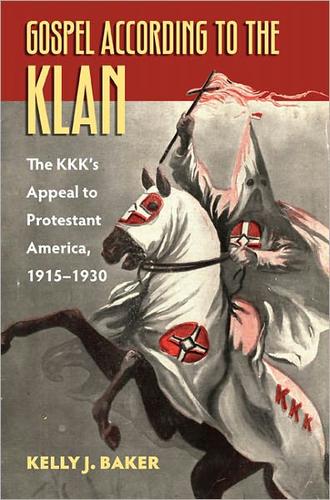
Gospel According to the Klan
0
0
As an Amazon Associate and affiliate partner, Menrva Books earns from qualifying purchases. Learn more
Author Description
To many Americans, modern marches by the Ku Klux Klan may seem like a throwback to the past or posturing by bigoted hatemongers. To Kelly Baker, they are a reminder of how deeply the Klan is rooted in American mainstream Protestant culture. Most studies of the KKK dismiss it as an organization of racists attempting to intimidate minorities and argue that the Klan used religion only as a rhetorical device. Baker contends instead that the KKK based its justifications for hatred on a particular brand of Protestantism that resonated with mainstream Americans, one that employed burning crosses and robes to explicitly exclude Jews and Catholics. To show how the Klan used religion to further its agenda of hate while appealing to everyday Americans, Kelly Baker takes readers back to its "second incarnation" in the 1920s. During that decade, the revived Klan hired a public relations firm that suggested it could reach a wider audience by presenting itself as a "fraternal Protestant organization that championed white supremacy as opposed to marauders of the night." That campaign was so successful that the Klan established chapters in all forty-eight states. Baker has scoured official newspapers and magazines issued by the Klan during that era to reveal the inner workings of the order and show how its leadership manipulated religion, nationalism, gender, and race. Through these publications we see a Klan trying to adapt its hate-based positions with the changing times in order to expand its base by reaching beyond a narrowly defined white male Protestant America. This engrossing expose looks closely at the Klan's definition of Protestantism, its belief in a strong relationship between church and state, its notions of masculinity and femininity, and its views on Jews and African Americans. The book also examines in detail the Klan's infamous 1924 anti-Catholic riot at Notre Dame University and draws alarming parallels between the Klan's message of the 1920s and current posturing
Menrva's Summary
THE THESIS
The Ku Klux Klan's enduring influence in American Protestant culture is examined through its historical use of religion to justify hate and exclusion. Kelly Baker, a historian, argues that the Klan's second incarnation in the 1920s was not merely a fringe movement but a force deeply embedded in mainstream Protestantism, appealing to a broad audience through carefully crafted public relations. The book analyzes how the Klan manipulated religious, nationalist, gender, and racial ideologies to expand its base, presenting itself as a fraternal organization championing white supremacy. Baker draws on Klan publications from the era to reveal the organization's internal workings and its strategies for adapting its message to contemporary society.
THE SCOPE MAP
- Analysis of the Klan's
THE AUTHORITY PERSPECTIVE
The book is recognized for its thorough examination of the Ku Klux Klan's historical ties to American Protestant culture, challenging the notion that the Klan's religious rhetoric was merely a superficial tool. Scholars and reviewers have noted Baker's meticulous research, which draws from official Klan publications of the 1920s to expose the organization's sophisticated use of religion, nationalism, gender, and race to appeal to a wider audience. The work is praised for its detailed exploration of the Klan's ideology, including its views on church-state relations, masculinity, and its exclusionist policies towards Jews and African Americans. Furthermore, the book's parallels drawn between the Klan's historical messaging and contemporary societal trends have been highlighted as particularly relevant and alarming.
Page Count:
326
Publication Date:
2011-01-01
ISBN-10:
0700617922
ISBN-13:
9780700617920
Non-Fiction
Religion
History
Sociology
American Studies
Community Tags
Similar Books