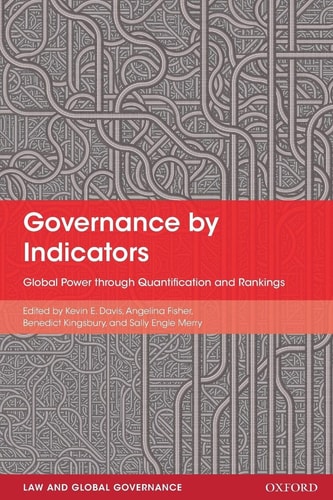
Governance by Indicators: Global Power through Quantification and Rankings
0
0
As an Amazon Associate and affiliate partner, Menrva Books earns from qualifying purchases. Learn more
Author Description
The use of indicators as a technique of global governance is increasing rapidly. Major examples include the World Bank's Doing Business Indicators, the World Bank's Good Governance and Rule of Law indicators, the Millennium Development Goals, and the indicators produced by Transparency International. Human rights indicators are being developed in the UN and regional and advocacy organizations. The burgeoning production and use of indicators has not, however, been accompanied by systematic comparative study of, or reflection on, the implications, possibilities, and pitfalls of this practice.This book furthers the study of these issues by examining the production and history of indicators, as well as relationships between the producers, users, subjects, and audiences of indicators. It also explores the creation, use, and effects of indicators as forms of knowledge and as mechanisms of making and implementing decisions in global governance. Using insights from case studies, empirical work, and theoretical approaches from several disciplines, the book identifies legal, policy, and normative implications of the production and use of indicators as a tool of global governance.
Menrva's Summary
THE THESIS
This book investigates the increasing reliance on quantitative indicators as a primary mechanism for global governance and the subsequent implications for power dynamics and decision-making. The authors, a multidisciplinary team of scholars including Angelina Fisher, Benedict Kingsbury, Kevin E. Davis, and Sally Engle Merry, analyze how these metrics function as both knowledge systems and regulatory tools. By synthesizing empirical case studies with theoretical frameworks, the text evaluates the history, production, and normative consequences of indicator-based governance in international institutions.
THE SCOPE MAP
What You Will Find
- Analysis of major indicator systems including the World Bank's Doing Business and Good Governance metrics.
- Examination of the relationships between producers, users, and subjects of global indicators.
- Theoretical exploration of indicators as mechanisms for implementing policy and legal decisions.
- Case studies detailing the development of human rights indicators within the UN and advocacy organizations.
THE AUTHORITY PERSPECTIVE
Experts identify this work as a foundational text for understanding the intersection of quantification and international law. Readers frequently note the academic density of the prose, which provides a rigorous examination of how data shapes global power structures.
Page Count:
504
Publication Date:
2015-07-21
Publisher:
Oxford University Press
ISBN-10:
0198747934
ISBN-13:
9780198747932
Law
International relations
Ranking and selection statistics
Sociology
Public Policy