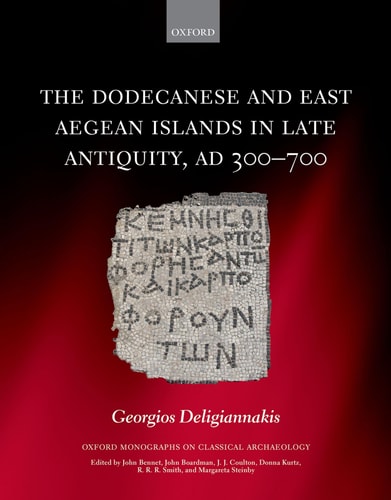
The Dodecanese and East Aegean Islands in Late Antiquity, AD 300-700
0
0
As an Amazon Associate and affiliate partner, Menrva Books earns from qualifying purchases. Learn more
Author Description
The Dodecanese and the Eastern Aegean Islands in Late Antiquity, AD 300-700 is a regional study of the history, archaeology, and religious profile of the Late Antique Dodecanese (the islands of the south-eastern Aegean, centered on Rhodes), exploring how the spread of Christianity altered these communities and how the prosperity of the eastern Roman Empire, and the new capital in Constantinople, affected their life. Incorporating comparative evidence from the rest of the Aegean islands and both the Greek and Turkish mainlands, the volume analyzes material from the whole area as part of a wider system of social and economic relations, political history, and culture.Accompanied by an extensive archaeological gazetteer, it presents the administrative and political history of the islands and considers the written and archaeological evidence for the monotheistic communities of the eastern Aegean, offering a closer examination of the late history of pagan temples and the transition to Christianity. It discusses the settlement and economic history of the islands, focusing on the urban history of Rhodes and Kos, but also on the numerous key non-urban sites from the rest of the islands, in particular the extended ruins of a barely known site located in the small island of Saria, north of Karpathos. The final chapter addresses the seventh century--which saw the destruction of so much of what had been built up in the fourth to sixth centuries--when the islands' societies acquired a new role for the State as naval outposts, functioning as a border zone in the course of the Arab-Byzantine wars.
Menrva's Summary
THE THESIS
This study investigates the socio-economic, political, and religious transformation of the Dodecanese and Eastern Aegean islands during the transition from Late Antiquity to the early Byzantine period. Georgios Deligiannakis, a specialist in the archaeology of the Aegean, synthesizes archaeological data and historical records to examine how the rise of Christianity and the influence of Constantinople reshaped island communities. The work argues that these islands functioned as a dynamic, interconnected system rather than isolated outposts, eventually adapting to the geopolitical pressures of the seventh-century Arab-Byzantine wars.
THE SCOPE MAP
What You Will Find
- A comprehensive analysis of urban and non-urban settlement patterns in Rhodes, Kos, and Saria.
- An extensive archaeological gazetteer documenting material evidence from the fourth to the seventh centuries.
- Comparative data integrating findings from the Greek and Turkish mainlands.
- A detailed examination of the transition from pagan temple sites to Christian ecclesiastical structures.
THE AUTHORITY PERSPECTIVE
Scholars recognize this monograph as a foundational resource for understanding the regional history of the Aegean during a period of significant structural change. The text is noted for its rigorous integration of archaeological fieldwork with administrative history, making it a standard reference for researchers in Late Antique studies.
Page Count:
320
Publication Date:
2016-05-24
Publisher:
Oxford University Press
ISBN-10:
0198745990
ISBN-13:
9780198745990
Religion
History
Greece
Byzantine History
Archaeology
Community Tags
Similar Books