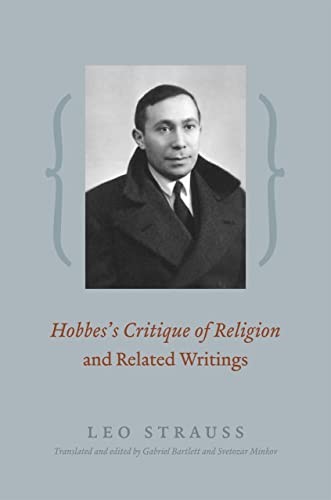
Hobbes's Critique of Religion & Related Writings
0
0
As an Amazon Associate and affiliate partner, Menrva Books earns from qualifying purchases. Learn more
Author Description
Leo Strauss's The Political Philosophy of Hobbes deservedly ranks among his most widely acclaimed works. In it Strauss argues that the basis for Hobbes's natural and political science is his interest in "self-knowledge of man as he really is." The writings collected in this book, each written prior to that classic volume, complement that account. Thus at long last, this book allows us to have a complete picture of Strauss's interpretation of Hobbes, the thinker pivotal to the fundamental theme of his life's work: the conflicting demands of philosophy and revelation, or as he termed it, "the theologico-political problem." It is no exaggeration to say that Strauss's work on Hobbes's critique of religion is essential to his analysis of Hobbes's political philosophy, and vice versa. This volume will spark new interest in Hobbes's explication of the Bible and in his understanding of religion by revealing previously neglected dimensions and motives of Hobbes's "theology." At the same time, scholars interested in the intellectual development of Leo Strauss will find in these writings the missing link, as it were, between his two early books, Spinoza's Critique of Religion and The Political Philosophy of Hobbes. In addition, this volume makes available for the first time in English a letter, a book outline, an extended review, an engagement with legal positivism, and an account of Strauss's work on Hobbes by Heinrich Meier, all of which shed light on Strauss's concerns and his approach to Hobbes in particular, as well as to modern political thought and life.
Menrva's Summary
THE THESIS
This volume investigates Leo Strauss's interpretation of Thomas Hobbes, focusing on Hobbes's critique of religion and its foundational role in his political science. Strauss argues that Hobbes's understanding of man and his political philosophy stem from an interest in self-knowledge. The collected writings, predating Strauss's classic work on Hobbes, illuminate this connection and reveal previously overlooked aspects of Hobbes's theological thought, offering a complete picture of Strauss's engagement with this pivotal thinker.
THE SCOPE MAP
- Leo Strauss's interpretation of Thomas Hobbes's political science and critique of religion.
- Analysis of Hobbes's interest in the self-knowledge of man as the basis for his philosophy.
- Exploration of Hobbes's explication of the Bible and his understanding of religion.
- Previously neglected dimensions and motives of Hobbes's "theology."
- Writings that serve as a link between Strauss's 'Spinoza's Critique of Religion' and 'The Political Philosophy of Hobbes'.
- First-time English availability of a letter, book outline, extended review, and engagement with legal positivism related to Strauss's work on Hobbes.
- An account of Strauss's work on Hobbes by Heinrich Meier.
THE AUTHORITY PERSPECTIVE
This collection is regarded as essential for understanding Leo Strauss's interpretation of Thomas Hobbes, particularly his views on the theologico-political problem. The writings presented here, which precede Strauss's major work on Hobbes, offer a comprehensive view of his thought and its development. They are noted for shedding light on Hobbes's critique of religion and his theological underpinnings, which are presented as foundational to his political philosophy. Furthermore, the volume is valuable for scholars tracking Strauss's intellectual trajectory, bridging his earlier work on Spinoza with his later Hobbesian studies.
Page Count:
167
Publication Date:
2011-01-01
ISBN-10:
0226776824
ISBN-13:
9780226776828
Philosophy
Religion
Non-Fiction
Political Philosophy
History of Ideas
Community Tags
Similar Books