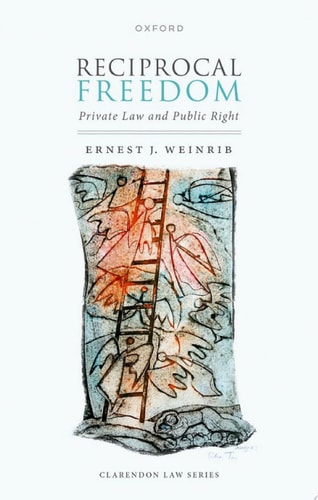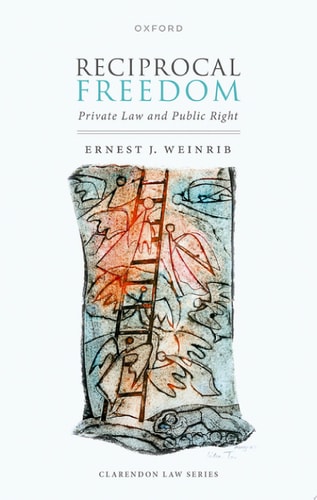
Reciprocal Freedom: Private Law and Public Right
0
0
As an Amazon Associate and affiliate partner, Menrva Books earns from qualifying purchases. Learn more
Author Description
Reciprocal Freedom elucidates the relationship between private law and the state, presenting reciprocal freedom as the normative idea underlying a legal order in which private law occupies a distinctive place. Weinrib develops a set of interconnected conceptions of private law, corrective justice, rights, ownership, the role of legal institutions, distributive justice, the relationship of constitutional rights to private law, and the rule of law.The book is explicitly Kantian in inspiration; it presents a non-instrumental account of law that is geared to the juridical character of the modern liberal state. Combining legal and philosophical analysis, it offers a sequenced and legally informed argument for understanding law as necessary to our co-existence as free beings.
Menrva's Summary
THE THESIS
This work investigates the normative foundations of private law by arguing that reciprocal freedom serves as the essential organizing principle for a modern liberal legal order. Ernest J. Weinrib, a prominent legal scholar, utilizes a Kantian philosophical framework to challenge instrumentalist views of law. He constructs a rigorous argument that positions private law not as a tool for social engineering, but as a necessary structure for the coexistence of free individuals within a state. By synthesizing legal doctrine with moral philosophy, the author provides a cohesive account of how corrective justice and rights function within a constitutional system.
THE SCOPE MAP
What You Will Find
- A comprehensive analysis of the relationship between private law and public right.
- A detailed examination of corrective justice versus distributive justice.
- Theoretical frameworks concerning ownership, rights, and the rule of law.
- A Kantian-inspired methodology for interpreting the juridical character of the state.
THE AUTHORITY PERSPECTIVE
Legal scholars and philosophers frequently cite this text as a significant contribution to the formalist tradition in jurisprudence. Readers often note the high level of academic density and the sophisticated philosophical rigor required to engage with the author's arguments.
Page Count:
240
Publication Date:
2022-12-22
Publisher:
Oxford University Press
ISBN-10:
0198754183
ISBN-13:
9780198754183
Philosophy
Jurisprudence
Legal Theory
Law