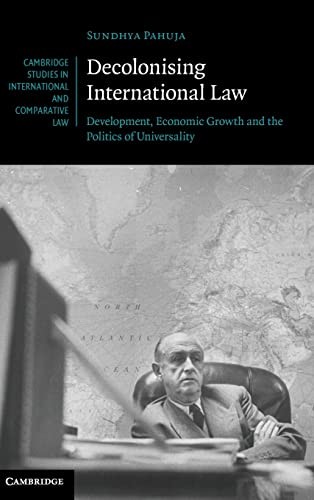
Decolonising International Law
0
0
As an Amazon Associate and affiliate partner, Menrva Books earns from qualifying purchases. Learn more
Author Description
The universal promise of contemporary international law has long inspired countries of the Global South to use it as an important field of contestation over global inequality. Taking three central examples, Sundhya Pahuja argues that this promise has been subsumed within a universal claim for a particular way of life by the idea of 'development'. As the horizon of the promised transformation and concomitant equality has receded ever further, international law has legitimised an ever-increasing sphere of intervention in the Third World. The post-war wave of decolonisation ended in the creation of the developmental nation-state, the claim to permanent sovereignty over natural resources in the 1950s and 1960s was transformed into the protection of foreign investors, and the promotion of the rule of international law in the early 1990s has brought about the rise of the rule of law as a development strategy in the present day
Menrva's Summary
THE THESIS
This book investigates how the universal promise of international law has been co-opted by the concept of 'development' to legitimize intervention in the Global South. Sundhya Pahuja examines three key historical examples to demonstrate how international law, initially seen as a tool for contesting global inequality, has instead become a mechanism for imposing a specific way of life. The book traces the transformation of post-colonial aspirations into the 'developmental nation-state', the shift from sovereignty over natural resources to the protection of foreign investors, and the contemporary rise of the 'rule of law' as a development strategy. Through this analysis, Pahuja argues that international law has increasingly served to justify intervention in the Third World as the ideal of equality has receded.
THE SCOPE MAP
- Analysis of the post-war wave of decolonisation and the creation of the developmental nation-state.
- Examination of the claim to permanent sovereignty over natural resources in the 1950s and 1960s and its transformation into the protection of foreign investors.
- Exploration of the promotion of the rule of international law in the early 1990s and the subsequent rise of the rule of law as a development strategy.
- Critique of how the idea of 'development' has subsumed the universal promise of international law.
- Demonstration of how international law has legitimized an increasing sphere of intervention in the Third World.
- Focus on the Global South's use of international law as a field of contestation over global inequality.
THE AUTHORITY PERSPECTIVE
The book is recognized for its critical examination of international law's role in global inequality and development. Pahuja's analysis highlights how the concept of 'development' has been used to justify intervention in the Global South, shifting the focus from decolonization to the protection of foreign investment and the 'rule of law' as a strategy. The work is understood as a significant contribution to debates on international legal theory and post-colonial studies, offering a nuanced perspective on the historical evolution of international legal norms and their impact on developing nations.
Page Count:
303
Publication Date:
2011-01-01
ISBN-10:
0521199034
ISBN-13:
9780521199032
History
Politics
Non-Fiction
Law
Community Tags
Similar Books