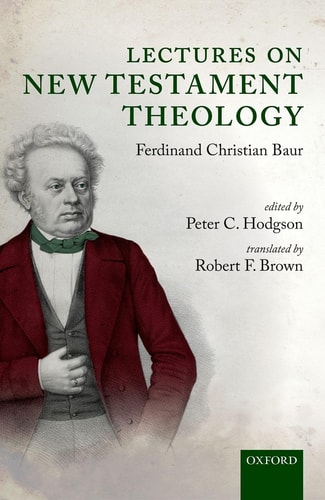
Lectures on New Testament Theology
0
0
As an Amazon Associate and affiliate partner, Menrva Books earns from qualifying purchases. Learn more
Author Description
Ferdinand Christian Baur (1792-1860), one of the great innovators in the study of the New Testament, argued that each of its books reflects the interests and tendencies of its author in a particular religio-historical milieu. A critique of the writings must precede any judgments about the historical validity of individual stories about Jesus in the Gospels. Thus Baur could move beyond the impasse created by Strauss's Life of Jesus. Baur demonstrated that the Gospel of John is not a historical document comparable to the Synoptic Gospels and cannot be used to reconstruct the teaching of Jesus, and that the Synoptic Gospels must be read critically and selectively. He applied the same principles to the Epistles, arguing that only four are genuinely Pauline (Galatians, 1 and 2 Corinthians, and Romans).Baur's Lectures on New Testament Theology, delivered in Tubingen during the 1850s, summarize thirty years of his research. The lectures begin with an Introduction on the concept, history, and organization of New Testament theology. Part One is devoted to the teaching of Jesus, which Baur finds most reliably in Matthew. Part Two contains the teaching of the Apostles in three chronological periods. The first period presents the theological frameworks of the Apostle Paul and the Book of Revelation; the second period, the frameworks of Hebrews, the Deutero-Pauline Epistles, James and Peter, the Synoptic Gospels and Acts; and the third period, those of the Pastoral Epistles and the Gospel of John.
Menrva's Summary
THE THESIS
This work investigates the core question of how the New Testament can be understood as a collection of historically situated documents reflecting the specific theological tendencies of their authors. Robert F. Brown presents these lectures as a synthesis of Ferdinand Christian Baur’s thirty years of research into the origins of Christianity. Baur utilizes a critical, historical-analytical framework to move beyond the limitations of previous scholarship, specifically addressing the historical validity of the Gospels and the authenticity of the Pauline Epistles. The text serves as a foundational document for the Tubingen School of theology, providing a systematic approach to reading biblical texts within their specific religio-historical milieus.
THE SCOPE MAP
What You Will Find
- A comprehensive analysis of the concept, history, and organization of New Testament theology.
- A critical evaluation of the teaching of Jesus, prioritizing the Gospel of Matthew as the most reliable source.
- A chronological framework for the teaching of the Apostles, divided into three distinct historical periods.
- A rigorous methodology for distinguishing between authentic Pauline epistles and later deutero-Pauline writings.
THE AUTHORITY PERSPECTIVE
Scholars recognize this text as a vital primary source for understanding the development of 19th-century critical biblical scholarship. Readers frequently note the academic density of the prose, which requires a strong background in historical theology to fully grasp the nuances of Baur's arguments.
Page Count:
416
Publication Date:
2016-05-24
Publisher:
Oxford University Press
ISBN-10:
0198754175
ISBN-13:
9780198754176
History
Religion
Philosophy
Theology
Community Tags
Similar Books