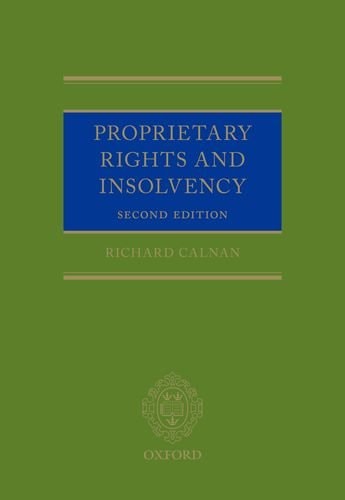
Proprietary Rights and Insolvency
0
0
As an Amazon Associate and affiliate partner, Menrva Books earns from qualifying purchases. Learn more
Author Description
This book explains how a creditor of an insolvent debtor can take priority over other creditors by claiming a proprietary interest in assets held by the debtor, and concentrates on the circumstances in which proprietary interests are created by operation of law or are implied from the arrangements between the parties.This is a subject of particular importance and difficulty in common law systems because of the changeable nature of equitable proprietary interests, and this book provides a clear and structured explanation of the current state of the law, with detailed reference to case law from England and Wales as well as Commonwealth jurisprudence, and suggests how it might be clarified and simplified by returning to first principles.The new edition considers a number of important developments which pertain to proprietary rights and insolvency. It evaluates the key decision of the Supreme Court in FHR European Ventures v Cedar Capital Partners. Although this has settled the question of whether constructive trusts extend to bribes, it has raised more general issues regarding the approach of the courts to the imposition of proprietary remedies, which the book explores. It also covers recent Privy Council and Court of Appeal decisions concerning constructive notice (Credit Agricole v Papadimitrou, Central Bank of Ecuador v Conticorp, and SFO v Lexi), as well as interesting issues concerning the new status of intangibles (Armstrong v Winnington) and the status of the anti-deprivation rule (Belmont Park v BNY).Proprietary Rights and Insolvency is a lucid and practical reference source on insolvency and property law.
Menrva's Summary
THE THESIS
This book investigates the complex mechanisms by which creditors establish priority over others in insolvency proceedings through the assertion of proprietary interests. Richard Calnan, an expert in commercial and insolvency law, examines how these interests arise through operation of law or contractual implication. The text provides a rigorous framework for navigating the intersection of equitable proprietary interests and insolvency, advocating for a return to first principles to clarify current legal ambiguities.
THE SCOPE MAP
What You Will Find
- Analysis of proprietary interests created by operation of law or implied arrangements.
- Evaluation of Supreme Court and Privy Council rulings including FHR European Ventures v Cedar Capital Partners and Belmont Park v BNY.
- Examination of constructive notice, the status of intangibles, and the anti-deprivation rule.
- Comparative legal analysis utilizing case law from England, Wales, and Commonwealth jurisdictions.
THE AUTHORITY PERSPECTIVE
Legal professionals and scholars frequently cite this work as a foundational reference for understanding the intersection of property rights and insolvency. Experts highlight the text for its ability to synthesize complex equitable principles into a practical guide for practitioners navigating high-stakes commercial disputes.
Page Count:
496
Publication Date:
2016-08-16
Publisher:
Oxford University Press
ISBN-10:
019875938X
ISBN-13:
9780198759386
Law
Property Law
Insolvency Law
Finance
Bankruptcy
Commercial law
Great Britain
Community Tags
Other Editions(3)

Similar Books