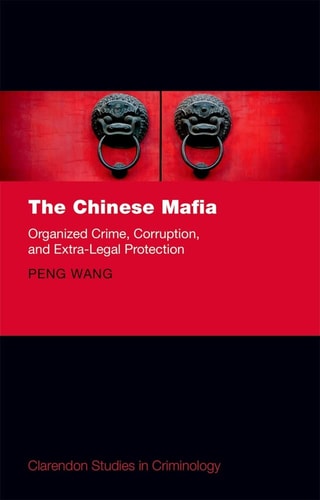
The Chinese Mafia: Organized Crime, Corruption, and Extra-Legal Protection
0
0
As an Amazon Associate and affiliate partner, Menrva Books earns from qualifying purchases. Learn more
Author Description
Utilising individual interviews and focus group discussions, primarily from two Chinese cities, The Chinese Mafia: Organized Crime, Corruption, and Extra-Legal Protection contributes to the understanding of organized crime and corruption in the Chinese context, filing a significant gap in criminological literature, by investigating how extra-legal protectors-corrupt public officials and street gangsters-emerge, evolve and operate in a rapidly changing society.China's economic reforms have been accompanied by a surge of social problems, such as ineffective legal institutions, booming black markets and rampant corruption. This has resulted in the rise of extra-legal means of protection and enforcement: such is the demand for protection that cannot be fulfilled by state-sponsored institutions. This book develops a new socio-economic theory of mafia emergence, incorporating Granovetter's argument on social embeddedness into Gambetta's economic theory of the mafia, to suggest that the rise of the Chinese mafia is primarily due to the negative influence of guanxi (a Chinese version of personal connections) on the effectiveness of the formal legal system. This interplay has two major consequences. First, the weakened ability of the formal legal system sees street gangsters (the 'Black Mafia') providing protection and quasi law enforcement. Second, it allows for escalating abuse of power by public officials; as a result, corrupt officials (the 'Red Mafia') sell public appointments, exchange illegal benefits with businesses and protect local gangs. Together, these outcomes have seen street gangs shift their operations away from traditional areas (e.g. gambling, prostitution and drug distribution), whilst corrupt public officials have moved to offer illegal services to the criminal underworld, including the safeguarding organized crime groups and protection of illegal entrepreneurs.A study of crime and deviance located within a fast growing economy, The Chinese Mafia offers a
Menrva's Summary
THE THESIS
This book investigates the socio-economic mechanisms driving the emergence of organized crime and systemic corruption within the context of China's rapid economic transition. Author Peng Wang utilizes a criminological framework to analyze how the failure of formal legal institutions creates a vacuum filled by extra-legal protectors. By synthesizing Granovetter’s theory of social embeddedness with Gambetta’s economic model of the mafia, the text argues that the cultural influence of guanxi undermines state authority, leading to a symbiotic relationship between street-level gangsters and corrupt public officials.
THE SCOPE MAP
What You Will Find
- Analysis of the 'Black Mafia' (street gangs) and 'Red Mafia' (corrupt officials) dynamics.
- A socio-economic theory explaining the rise of extra-legal protection markets.
- Empirical data derived from individual interviews and focus group discussions in two major Chinese cities.
- Examination of how economic reforms and ineffective legal institutions facilitate the growth of black markets.
THE AUTHORITY PERSPECTIVE
Experts identify this work as a significant contribution to the study of crime in transitional economies, particularly for its nuanced application of social network theory to the Chinese context. Readers frequently note the academic density of the prose and the value of the primary source data in understanding the intersection of state power and criminal enterprise.
Page Count:
252
Publication Date:
2017-03-26
Publisher:
Oxford University Press
ISBN-10:
0198758405
ISBN-13:
9780198758402
Non-Fiction
Mafia
Crime
Sociology
Criminology
Community Tags
Similar Books