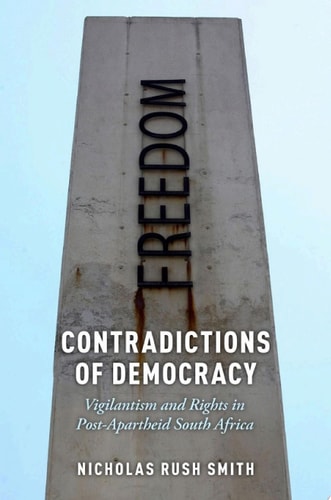
Contradictions of Democracy: Vigilantism and Rights in Post-Apartheid South Africa
0
0
As an Amazon Associate and affiliate partner, Menrva Books earns from qualifying purchases. Learn more
Author Description
Despite being one of the world's most vibrant democracies, police estimate between five and ten percent of the murders in South Africa result from vigilante violence. This is puzzling given the country's celebrated transition to democracy and massive reform of the state's legal institutions. Where most studies explain vigilantism as a response to state or civic failure, in Contradictions of Democracy, Nicholas Rush Smith illustrates that vigilantism is actually a response to the processes of democratic state formation. In the context of densely networked neighborhoods, vigilante citizens often interpret the technical success of legal institutions-for instance, the arrest and subsequent release of suspects on bail-as failure and work to correct such perceived failures on their own. Smith also shows that vigilantism provides a new lens through which to understand democratic state formation. Among young men of color in some parts of South Africa, fear of extra-judicial police violence is common. Amid such fear, instead of the state seeming protective, it can appear as something akin to a massive vigilante organization. An insightful look into the high rates of vigilantism in South Africa and the general challenges of democratic state building, Contradictions of Democracy explores fundamental questions about political order, the rule of law, and democratic citizenship.
Menrva's Summary
THE THESIS
This book investigates why high levels of vigilante violence persist in South Africa despite the country's successful transition to a democratic state and the implementation of significant legal reforms. Nicholas Rush Smith, a scholar of political science, utilizes extensive ethnographic research and neighborhood-level analysis to challenge the conventional view that vigilantism is merely a symptom of state failure. Instead, he argues that vigilante activity is a direct, albeit paradoxical, response to the specific mechanisms of democratic state formation and the public's interpretation of legal institutional processes.
THE SCOPE MAP
What You Will Find
- Analysis of the relationship between democratic legal institutions and extra-judicial violence.
- Examination of how neighborhood social networks influence perceptions of justice.
- Case studies focusing on the experiences of young men of color in South Africa.
- A theoretical framework linking state-building processes to local vigilante practices.
Scope Limits
- The study does not provide a comprehensive history of all South African crime statistics.
- It does not offer a policy manual for immediate police reform or crime prevention.
THE AUTHORITY PERSPECTIVE
Scholars and political analysts recognize this work as a significant contribution to the study of democratic consolidation and the complexities of the rule of law in post-colonial contexts. Readers frequently note the academic density of the prose, which provides a rigorous examination of the intersection between state legitimacy and grassroots political action.
Page Count:
264
Publication Date:
2019-01-01
Publisher:
Oxford University Press
ISBN-10:
0190847212
ISBN-13:
9780190847210
Ethnic Studies
Criminology
Sociology
Crime
South Africa
African history
Professional Career & Trade
Cultural Anthropology
Human rights
Comparative Politics
Democracy Studies
Community Tags
Similar Books