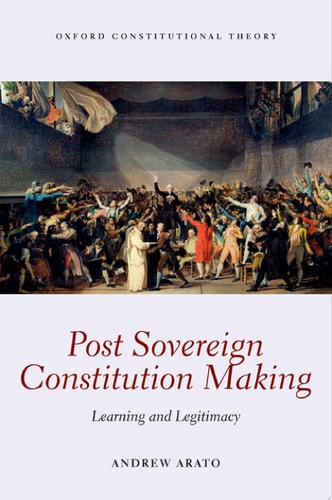
Post Sovereign Constitutional Making: Learning and Legitimacy
0
0
As an Amazon Associate and affiliate partner, Menrva Books earns from qualifying purchases. Learn more
Author Description
Constitutional politics has become a major terrain of contemporary struggles. Contestation around designing, replacing, revising, and dramatically re-interpreting constitutions is proliferating worldwide. Starting with Southern Europe in post-Franco Spain, then in the ex-Communist countries in Central Europe, post-apartheid South Africa, and now in the Arab world, constitution making has become a project not only of radical political movements, but of liberals and conservatives as well. Wherever new states or new regimes will emerge in the future, whether through negotiations, revolutionary process, federation, secession, or partition, the making of new constitutions will be a key item on the political agenda.Combining historical comparison, constitutional theory, and political analysis, this volume links together theory and comparative analysis in order to orient actors engaged in constitution making processes all over the world. The book examines two core phenomena: the development of a new, democratic paradigm of constitution making, and the resulting change in the normative discussions of constitutions, their creation, and the source of their legitimacy. After setting out a theoretical framework for understanding these developments, Andrew Arato examines recent constitutional politics in South Africa, Hungary, Turkey, and Latin America and discusses the political stakes in constitution-making. The book concludes by offering a systematic critique of the alternative to the new paradigm, populism and populist constituent politics.
Menrva's Summary
THE THESIS
This volume investigates the emergence of a new, democratic paradigm of constitution-making and its implications for political legitimacy in contemporary global struggles. Andrew Arato, a scholar of political theory and constitutionalism, utilizes a comparative historical framework to analyze how diverse nations navigate the design, replacement, and revision of foundational legal documents. By synthesizing constitutional theory with empirical political analysis, the author provides a normative assessment of how modern states establish authority during periods of transition.
THE SCOPE MAP
What You Will Find
- Comparative analysis of constitutional processes in South Africa, Hungary, Turkey, and Latin America.
- A theoretical framework for evaluating the legitimacy of post-sovereign constitution-making.
- Critical examination of the tension between democratic constitutionalism and populist political movements.
- Historical synthesis of constitutional developments from post-Franco Spain to the contemporary Arab world.
THE AUTHORITY PERSPECTIVE
Experts identify this work as a significant contribution to the field of comparative constitutional theory, particularly for its focus on the procedural legitimacy of new regimes. Readers frequently note the academic density of the prose, which is intended for scholars and practitioners engaged in political reform and legal studies.
Page Count:
300
Publication Date:
2016-05-10
Publisher:
Oxford University Press
ISBN-10:
0198755988
ISBN-13:
9780198755982
History
Constitutional Law
Law
Government
Community Tags
Similar Books