Marxism and the City
0
0
As an Amazon Associate and affiliate partner, Menrva Books earns from qualifying purchases. Learn more
Author Description
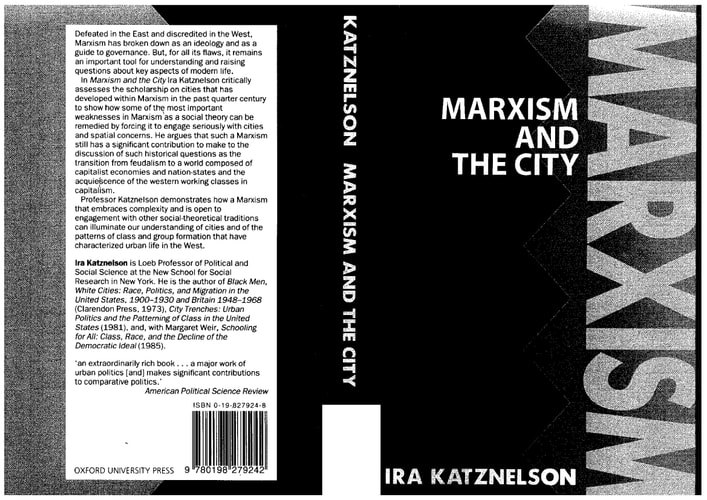
Defeated in the East and discredited in the West, Marxism has broken down as an ideology as well as a guide to governance. For all its profound and infirming flaws as a total ensemble of understanding and rule, Marxism remains an important tool for comprehending and questioning key aspects of modernity. In this work, Katznelson critically analyzes the development of Marxist scholarship on cities in the last quarter century. He not only demonstrates how some of the most important weaknesses in Marxism as a social theory can be remedied by forcing it to seriously engage with cities and spatial concerns, but explains the significant shortcomings even of this "improved" Marxism. Katznelson explores how a Marxism that is open to engagement with other social-theoretical traditions can help illuminate our understanding of cities and the patterns of class and group formation that have characterized urban life in the West. Clearly written, this book will interest not only students and scholars of social and political theory, but those involved with sociology, geography and political science as well as anyone concerned with urban studies.
Menrva's Summary
THE THESIS
Can Marxist social theory effectively account for the complexities of urban life and spatial development in the modern era? Ira Katznelson, a prominent scholar in political science and urban studies, evaluates the historical limitations of Marxist thought when applied to the city. He argues that while traditional Marxism often fails as a totalizing ideology, it remains a vital analytical tool if it is synthesized with other social-theoretical traditions to address class formation and urban spatial dynamics.
THE SCOPE MAP
What You Will Find
- A critical review of Marxist scholarship on urban development over the last twenty-five years.
- An analysis of the intersection between class formation and urban spatial patterns in Western societies.
- A methodological framework for integrating non-Marxist social theories into urban analysis.
- An assessment of the inherent weaknesses and potential remedies for Marxism as a tool for understanding modernity.
THE AUTHORITY PERSPECTIVE
Scholars and students of political theory frequently cite this work as a foundational text for understanding the evolution of urban-focused Marxist critique. Experts highlight the author's ability to maintain a balanced, critical distance from his subject matter while providing a rigorous academic framework for future research.
Page Count:
336
Publication Date:
1992-05-28
Publisher:
Oxford University Press
ISBN-10:
0198761147
ISBN-13:
9780198761143
Geography
Communism
Marxism
Social Theory
Urban Studies
Sociology