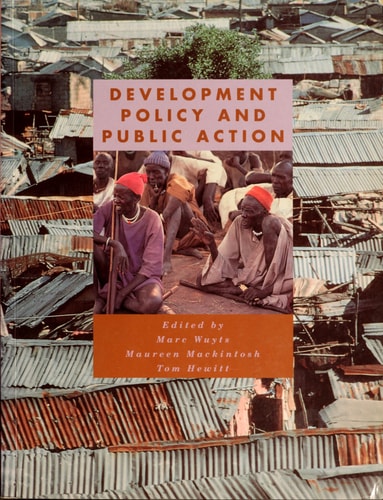
Development Policy and Public Action
0
0
As an Amazon Associate and affiliate partner, Menrva Books earns from qualifying purchases. Learn more
Author Description
This book concentrates on public action for development, 'Public action' means not only the actions of the state - central and local government - but also the activities of other bodies which influence the development process: non-governmental organizations, community organizations, political movements. One of the central objectives of the book is to try to understand state action as embedded in and influenced by these wider forms of public action.In this, the book takes an original approach to development policy analysis: by asking not, 'what should be done?', but 'who is doing what, with what effect, and why?' Hence 'policy' is not merely a set of decisions to be implemented by bureaucracies. It is a process of interaction between different forms of public action and response, with all those forms of public action, including the internal processes of the state, a matter of relevance for policy makers.The book is divided into five sections. Each section consists of a theory-based chapter, which is then illustrated by a case study. This structure allows the reader to see the results of theoretical ideas as applied to real countries and the lives of their people. The chapters are written by specialist authors using key questions, diagrams, tables, photographs and summaries to illustrate and clarify the text. It will be invaluable to undergraduate and postgraduate students of development studies, geography, history, economics, anthropology or international politics, as well as to development practitioners. It will be particularly useful to those joining the staff of official development agencies or non-governmental organizations.
Menrva's Summary
THE THESIS
This book investigates how public action, encompassing both state and non-state entities, shapes the complex processes of development policy. The authors, Marc Wuyts, Maureen Mackintosh, and Tom Hewitt, challenge traditional top-down policy models by framing development as an interactive, multi-layered process. They argue that state action cannot be understood in isolation and must be analyzed as being deeply embedded within the activities of community organizations, NGOs, and political movements. By shifting the analytical focus from prescriptive 'what should be done' questions to descriptive 'who is doing what' inquiries, the text provides a framework for understanding the real-world outcomes of development interventions.
THE SCOPE MAP
What You Will Find
- Theoretical analysis of state and non-state interaction in development.
- Case studies illustrating the application of development theories to real-world contexts.
- Pedagogical tools including diagrams, tables, and photographs to clarify complex policy concepts.
- A multi-disciplinary framework suitable for economics, geography, and political science.
THE AUTHORITY PERSPECTIVE
Experts and academics frequently cite this work as a foundational text for students and practitioners entering the field of international development. Readers often note the clarity of the case-study-driven structure, which effectively bridges the gap between abstract economic theory and practical policy implementation.
Page Count:
314
Publication Date:
1993-03-25
Publisher:
Oxford University Press
ISBN-10:
0198773366
ISBN-13:
9780198773368
Politics
Economics
International relations
Sociology
Public Policy
Community Tags
Similar Books