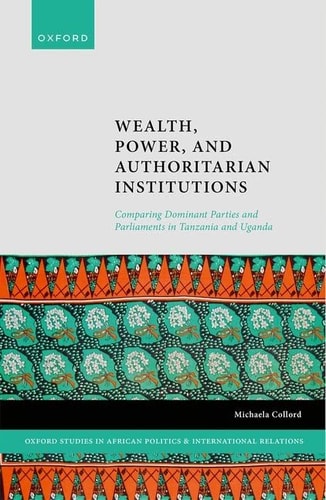
Wealth, Power, and Authoritarian Institutions: Comparing Dominant Parties and Parliaments in Tanzania and Uganda
0
0
As an Amazon Associate and affiliate partner, Menrva Books earns from qualifying purchases. Learn more
Author Description
Through An Analysis Of The Recent Political History Of Tanzania And Uganda, Wealth, Power And Authoritarian Institutions Offers A Novel Explanation Of Why Authoritarian Parties And Legislatures Vary In Strength, And Why This Variation Matters. Authoritarian Political Institutions Reflect-and To Some Extent, Magnify-elite Power Dynamics. They Are A Terrain Of Contest, An Arena Where Power Is Tested, Negotiated, And Re-ordered. While There Are Many Sources Of Elite Power, The Book Centres On Material Power, Exploring How The Socio-economic Foundations Of A Regime Affect Its Institutional Landscape. This Analysis First Considers How Diverse Trajectories Of State-led Capitalist Development Shape Divergent Patterns Of Wealth Accumulation Across Regimes. Where Accumulation Is More Closely Controlled By State And Party Leaders, As Was True In Tanzania Until Economic Liberalisation In The 1980s, Rival Factions Remain Subdued. Ruling Parties Can Then Build Up Relatively Strong Institutional Structures And Parliament Remains Marginal. Conversely, Where A Class Of Private Wealth Accumulators Expands, As Occurred In Tanzania After The 1980s And In Uganda After The National Resistance Movement Took Power In 1986, Rival Patron-client Factions Can More Easily Form. Factional Rivalries Then Channel Through The Ruling Party And Into The Legislature, Simultaneously Eroding Party Institutions And Encouraging Greater Legislative Strength. Finally, The Book Reflects On The Significance Of A Stronger Legislature, Particularly For Distributive Politics. It Details Mechanisms Through Which Legislatures, As Terrains Of Contest, Contribute To Both Regressive And Progressive Redistributive Outcomes. To Support Its Analysis, The Book Draws On Extensive Fieldwork In Tanzania And Uganda-- Provided By Publisher.
Menrva's Summary
THE THESIS
This book investigates why authoritarian parties and legislatures exhibit varying levels of strength and how these institutional differences influence political outcomes. Michaela Collord, a scholar of African politics, utilizes a comparative framework to analyze the political histories of Tanzania and Uganda. She argues that the socio-economic foundations of a regime, specifically the patterns of wealth accumulation, dictate the internal dynamics of ruling parties and the subsequent power of legislative bodies.
THE SCOPE MAP
What You Will Find
- Comparative analysis of political development in Tanzania and Uganda from the post-independence era to the present.
- A theoretical framework linking material power and elite wealth accumulation to institutional stability.
- Examination of how factionalism within ruling parties impacts the legislative process.
Scope Limits
- The analysis focuses primarily on the specific political trajectories of Tanzania and Uganda rather than a broad survey of all African authoritarian regimes.
- The study does not provide a comprehensive history of all state institutions, focusing instead on the interplay between parties and parliaments.
THE AUTHORITY PERSPECTIVE
Scholars in the field of African politics recognize this work as a rigorous contribution to the study of authoritarian institutional variation. Readers frequently note the academic density of the prose and the depth of the primary fieldwork presented by the author.
Page Count:
320
Publication Date:
2024-01-01
Publisher:
Oxford University Press
ISBN-10:
0192855182
ISBN-13:
9780192855183
Politics
Authoritarianism
International relations
Systems Theory
Comparative Politics
Community Tags
Similar Books