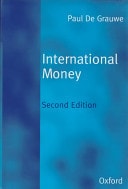
International Money: Postwar Trends and Theories
0
0
As an Amazon Associate and affiliate partner, Menrva Books earns from qualifying purchases. Learn more
Author Description
The period since the Second World War has been an eventful and often disturbing one in the international monetary field. Economic theories have been propounded and modified both to explain these events and to influence future choices made by economic actors. This history of international monetary relations shows both how theoretical development affected private developments, and how the theories themselves have been judged - and often discarded - on the basis of their perceived accordance with actuality. Exchange rate movements in particular are examined in the light of the absence of any generally accepted fundamental model, and the author deploys here his own theory based on the idea of bounded rationality. Finally, he looks ahead to future possibilities for the international monetary system. New in the Second Edition Fully revised and updated Includes an account of the EMS up till the end of 1995 Fuller theoretical coverage of fixed exchange rate systems, including the modelling of speculative attacks Covers chaos theory and near-rational behaviour Includes new sections on: speculators and speculative bubbles; target zones and other proposals for international monetary reform; the importance of free capital mobility and proposals to control capital movements
Menrva's Summary
THE THESIS
This book investigates the evolution of international monetary relations since the Second World War, questioning how economic theories have both shaped and been discarded by real-world financial events. Paul De Grauwe, a prominent economist, utilizes his extensive academic background to analyze the interplay between theoretical models and historical reality. He specifically evaluates the failure of traditional models to explain exchange rate volatility, proposing an alternative framework centered on the concept of bounded rationality to better understand market behavior.
THE SCOPE MAP
What You Will Find
- Historical analysis of international monetary relations from 1945 through 1995.
- Theoretical modeling of fixed exchange rate systems and speculative attacks.
- Application of chaos theory and near-rational behavior to financial markets.
- Evaluation of international monetary reform proposals, including target zones and capital mobility controls.
THE AUTHORITY PERSPECTIVE
Experts recognize this text as a significant contribution to the study of international finance, particularly for its critical examination of exchange rate dynamics. Readers frequently note the academic density of the prose, which serves as a foundational resource for understanding the limitations of classical economic models in a globalized market.
Page Count:
288
Publication Date:
1996-01-01
Publisher:
Oxford University Press
ISBN-10:
0198775148
ISBN-13:
9780198775140
History
Economics
Finance
International relations
Community Tags
Similar Books