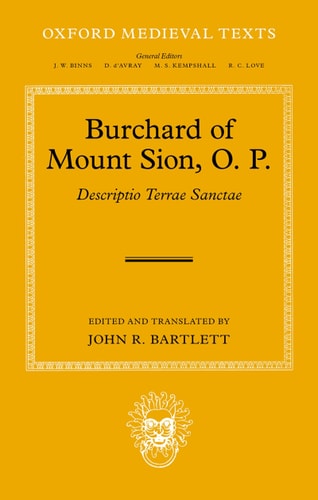
Burchard of Mount Sion, O. P.: Descriptio Terrae Sanctae
0
0
As an Amazon Associate and affiliate partner, Menrva Books earns from qualifying purchases. Learn more
Author Description
In his 'Description of the Holy Land', written in Latin around 1283, the Dominican Burchard explores the land in a series of itineraries starting from Acre in the north, and then from Jerusalem in the south. His particular concern is to identify and describe towns and other sites mentioned in the Bible as an aid to pilgrims and biblical scholars. He treated the evidence of the Bible and other sources carefully, he used the evidence of place-names preserved from antiquity, and he knew the land from personal observation, not simply from the writings of his predecessors. His identifications (e.g., of Dan and Beersheba) are not always supported by modern archaeological evidence, but he understood the importance of it, as shown by his explanation of the survival below ground level of early Christian sites, and his discussion of the site of ancient Jerusalem.Burchard's work exists in both a longer and a shorter, abbreviated, version. This book contains the Latin texts, drawn from selected manuscripts, complete with apparatus criticus, and translations of both versions. Introductory chapters cover what is known of Burchard and his career, the manuscript evidence for his two versions of the Descriptio and their relationship, an account of the different printed editions of Burchard's work, a study of his presentation of the geography of the land, and a discussion of early maps showing knowledge of his work. Further chapters explore the churches visited by Burchard, and his use of scripture and other written sources.Burchard names over four hundred places; the identification of biblical places is central to his work. Consistency in the spelling of biblical place-names deriving from ancient Hebrew or Greek and handed down via Latin, Arabic, and through many biblical translations in different languages, is well-nigh impossible. This book includes a list of the Latin names used by Burchard, together with their English equivalents as commonly used by modern scholars, and also as
Menrva's Summary
THE THESIS
This volume investigates the historical and geographical accuracy of Burchard of Mount Sion’s 13th-century account of the Holy Land to determine its utility for medieval pilgrims and modern scholars. John R. Bartlett, an expert in biblical geography, provides a comprehensive critical edition of the 'Descriptio Terrae Sanctae.' By analyzing both the long and short versions of the text, Bartlett evaluates how Burchard synthesized biblical scripture, classical sources, and personal observation to map the topography of the Levant. The work serves as a scholarly bridge between medieval pilgrimage literature and the development of historical geography.
THE SCOPE MAP
What You Will Find
- A complete critical edition of the Latin texts for both the long and short versions of the Descriptio.
- English translations alongside the original Latin with extensive apparatus criticus.
- Analysis of manuscript history, including the relationship between different versions and early printed editions.
- A detailed index of over four hundred place-names with modern scholarly equivalents.
- Introductory chapters covering Burchard’s biography and his methodology for identifying biblical sites.
THE AUTHORITY PERSPECTIVE
Scholars and historians regard this volume as a foundational resource for understanding medieval perceptions of the Holy Land. Readers frequently note the academic density of the prose and the meticulous nature of the editorial apparatus, which makes it an essential reference for those studying medieval cartography and biblical topography.
Page Count:
528
Publication Date:
2019-07-16
Publisher:
Oxford University Press
ISBN-10:
0198789513
ISBN-13:
9780198789512
Religion
History
Travel
Archaeology
Geography
Community Tags
Similar Books