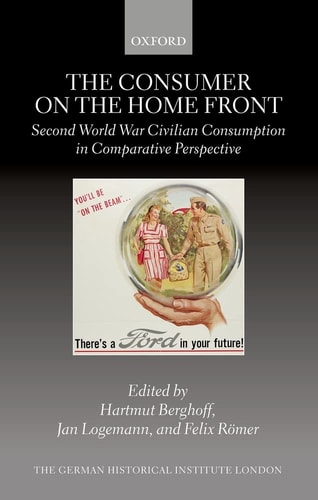
The Consumer on the Home Front: Second World War Civilian Consumption in Comparative Perspective
0
0
As an Amazon Associate and affiliate partner, Menrva Books earns from qualifying purchases. Learn more
Author Description
The term 'home front' gained currency during the First World War and was closely associated with the idea of 'total war' - it encapsulated the blurred lines between the armies fighting in the field and the civilian societies at home. It became one of the most consequential elements in Second World War strategic thinking, entailing an unparalleled degree of civilian mobilization. And the legacies of the home fronts reached far beyond 1945: the war became a crucial catalyst for broader social developments, including the emergence of mass consumer societies in the twentieth century.This volume explores the history of the home fronts in the Second World War from a comparative and transnational perspective, focusing on the role of the consumer and civilian morale in Nazi Germany, Japan, the Soviet Union, the United Kingdom, Canada, and the United States. The volume covers a wide range of aspects. It compares the belligerents' efforts in securing civilian food and nutrition. It analyses the role of advertising and commercial entertainment in creating 'virtual consumption' to compensate for wartime hardships. It highlights fashion as a means of offering distraction and promoting promises of future consumption. And it enquires into the impact of the wartime consumer regimes on the post-war period and long-term developments.This collection of ground-breaking international research will advance scholarship at various levels. It will contribute to our understanding of the entanglements between war and society in the twentieth century. And it will introduce a more holistic transnational perspective that aims to integrate the Second World War into the thriving historiography on mass consumption.
Menrva's Summary
THE THESIS
This volume investigates how the mobilization of civilian populations and the management of consumption during the Second World War functioned as a critical catalyst for the development of modern mass consumer societies. The authors, including historians Felix Römer, Hartmut Berghoff, and Jan Logemann, utilize a comparative and transnational framework to examine how belligerent nations balanced wartime scarcity with the need to maintain civilian morale. By analyzing state-led efforts to regulate food, fashion, and entertainment, the text argues that the wartime home front was not merely a site of deprivation but a laboratory for the consumer regimes that emerged in the post-war era.
THE SCOPE MAP
What You Will Find
- Comparative analysis of civilian morale and consumption policies in Nazi Germany, Japan, the Soviet Union, the United Kingdom, Canada, and the United States.
- Examination of state-managed food and nutrition programs during total war.
- Analysis of the role of advertising, commercial entertainment, and fashion as tools for psychological distraction.
- Longitudinal study of how wartime consumer regimes influenced long-term social and economic developments after 1945.
THE AUTHORITY PERSPECTIVE
Experts identify this collection as a significant contribution to the historiography of twentieth-century mass consumption and total war. Readers frequently note the academic density of the prose, which serves as a foundational text for scholars interested in the intersection of military history and social economics.
Page Count:
380
Publication Date:
2017-03-26
Publisher:
Oxford University Press
ISBN-10:
0198784260
ISBN-13:
9780198784265
Economics
History
Military History
Social History
Consumer Studies
Consumption Economics
Community Tags
Similar Books