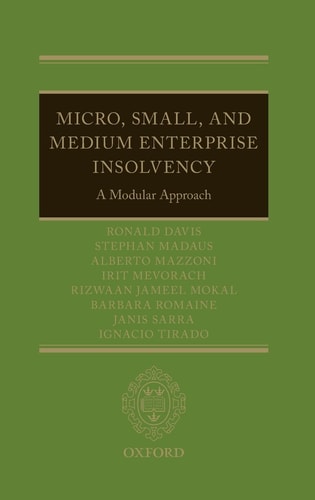
Micro, Small, and Medium Enterprise Insolvency: A Modular Approach
0
0
As an Amazon Associate and affiliate partner, Menrva Books earns from qualifying purchases. Learn more
Author Description
This new book systematically examines the current process for distressed Micro, Small and Medium Enterprises (MSMEs), and proposes a different, more appropriate, 'modular' approach to the treatment of such entities when faced with insolvency proceedings.MSMEs play a vital role in virtually all global economies. They are a primary means by which entrepreneurs bring new business propositions to the market, and deliver a range of products and services to local economies. MSMEs tend to be more reliant on favourable legal and regulatory climates to survive and thrive than larger businesses, and insolvency regimes are often more tailored to these larger businesses, assuming an extensive insolvency estate of significant worth, and the presence of creditors and other concerned stakeholders to participate in and oversee the process. These assumptions and features are generally incongruous with the reality of MSMEs, for whom assets are of less value and whose stakeholders are generally more disinterested.The modular approach proposed in this book addresses the imbalances, inconsistencies, and lack of supervision which is often apparent in treatment of insolvent MSMEs. It provides an overview of existing approaches to MSME insolvency, the place of MSMEs in the global economy, and the particular needs of MSMEs in financial distress. It then sets out the procedural framework, policy objectives, and key components of the modular approach, detailing how a choice of modules enables national policy-makers a more flexible process for resolution. It then outlines the roles, positions, and obligations of key stakeholder groups, and explains the managerial, administrative, and judicial functions of this approach. Finally, it explains how elements of the broader legal system should be aligned with, and supportive of, the optimal functioning of the modular approach.
Menrva's Summary
THE THESIS
This book investigates the systemic inadequacy of traditional insolvency regimes when applied to Micro, Small, and Medium Enterprises (MSMEs) and proposes a flexible, modular framework for their resolution. The authors, a distinguished group of legal scholars and jurists, utilize comparative international data and economic analysis to argue that current laws are designed for large corporations and fail to account for the unique constraints of smaller entities. By shifting away from rigid, one-size-fits-all procedures, the text provides a policy-oriented blueprint that allows national governments to tailor insolvency mechanisms to the specific needs of local economies.
THE SCOPE MAP
What You Will Find
- A comprehensive analysis of the economic role of MSMEs in global markets.
- A detailed procedural framework for implementing a modular insolvency approach.
- Case studies and comparative overviews of existing international insolvency regimes.
- Defined roles and obligations for stakeholders, including managerial, administrative, and judicial functions.
THE AUTHORITY PERSPECTIVE
Legal scholars and policy-makers identify this work as a significant contribution to the field of international commercial law. Experts highlight the text as a foundational resource for those seeking to reform national insolvency frameworks to better support small business sustainability.
Page Count:
256
Publication Date:
2018-12-11
Publisher:
Oxford University Press
ISBN-10:
0198799934
ISBN-13:
9780198799931
Business
Economics
Finance
Law
Bankruptcy
Insolvency
Public Policy
Small Business
Community Tags
Similar Books




Reader Comments
Share Your Thoughts
No comments yet. Be the first to share your thoughts!