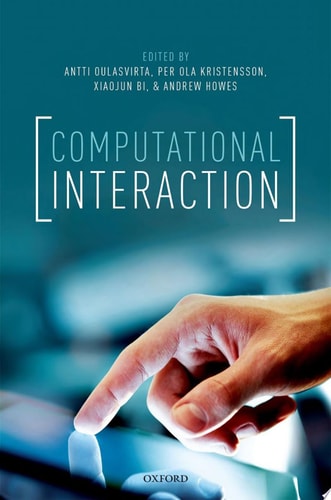
Computational Interaction
0
0
As an Amazon Associate and affiliate partner, Menrva Books earns from qualifying purchases. Learn more
Author Description
This book presents computational interaction as an approach to explaining and enhancing the interaction between humans and information technology. Computational interaction applies abstraction, automation, and analysis to inform our understanding of the structure of interaction and also to inform the design of the software that drives new and exciting human-computer interfaces. The methods of computational interaction allow, for example, designers to identify user interfaces that are optimal against some objective criteria. They also allow software engineers to build interactive systems that adapt their behaviour to better suit individual capacities and preferences.Embedded in an iterative design process, computational interaction has the potential to complement human strengths and provide methods for generating inspiring and elegant designs.Computational interaction does not exclude the messy and complicated behaviour of humans, rather it embraces it by, for example, using models that are sensitive to uncertainty and that capture subtle variations between individual users. It also promotes the idea that there are many aspects of interaction that can be augmented by algorithms.This book introduces computational interaction design to the reader by exploring a wide range of computational interaction techniques, strategies and methods. It explains how techniques such as optimisation, economic modelling, machine learning, control theory, formal methods, cognitive models and statistical language processing can be used to model interaction and design more expressive, efficient and versatile interaction.
Menrva's Summary
THE THESIS
This book investigates how computational interaction serves as a framework for explaining and improving the relationship between human users and information technology. The authors, a team of experts in human-computer interaction and computer science, argue that by applying abstraction, automation, and analysis, designers can create software that is both optimal and adaptive. They present a methodology that integrates algorithmic modeling with an understanding of human behavior to enhance the design of interactive systems.
THE SCOPE MAP
What You Will Find
- Optimization and economic modeling techniques for interface design
- Application of machine learning and control theory in system development
- Use of cognitive models to account for individual user variations
- Statistical language processing for expressive and efficient interaction
THE AUTHORITY PERSPECTIVE
Experts identify this work as a comprehensive introduction to the intersection of algorithmic design and user experience. Readers frequently note the technical density of the prose, making it a foundational text for researchers and advanced practitioners in the field of human-computer interaction.
Page Count:
432
Publication Date:
2018-04-08
Publisher:
Oxford University Press
ISBN-10:
0198799608
ISBN-13:
9780198799603
Human Interaction
Technology
Software Engineering
Design
Computer Science
Community Tags
Similar Books