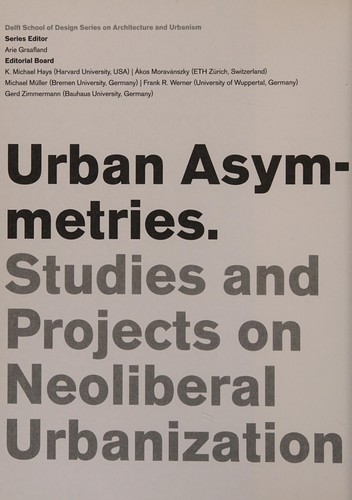
Urban Asymmetries
0
0
As an Amazon Associate and affiliate partner, Menrva Books earns from qualifying purchases. Learn more
Author Description
The onset of the current global economic crisis provides the perfect backdrop for reviewing the dire consequences that neoliberal urban policies have had upon the city, and for discussing possible alternatives to market-driven development. In this light "Urban asymmetries" centres on the contradictions of uneven urban development as a means of providing both a substantial critique of the current urban condition and a discussion of necessary counter practices, policies and strategies for designing in such environments, and inferring that social betterment within the city is possible by strategic use of the tools available to the urbanist and to the architect. The book aims to disprove some of the prevailing disciplinary discourses in architecture and urbanism which see the city as 'a given' rather than as an evolving socio-historic phenomenon, and intends to challenge the ubiquitous understanding of architecture as devoid of any social transformative power.
Menrva's Summary
THE THESIS
The book critically examines the negative impacts of neoliberal urban policies and explores alternative approaches to urban development. It argues against the notion of the city as a fixed entity, instead viewing it as a dynamic socio-historical construct. The author posits that social improvement within urban environments is achievable through the strategic application of tools available to urbanists and architects, challenging the perception that architecture lacks transformative social power.
THE SCOPE MAP
- Critique of neoliberal urban policies and their consequences.
- Discussion of uneven urban development and its contradictions.
- Exploration of counter practices, policies, and strategies for designing in challenging urban environments.
- Argument for the social transformative power of architecture and urbanism.
- Analysis of the city as an evolving socio-historic phenomenon.
- Examination of market-driven development versus alternative models.
THE AUTHORITY PERSPECTIVE
The book offers a substantial critique of the current urban condition, focusing on the contradictions inherent in uneven urban development driven by neoliberal policies. It aims to provide a framework for understanding how social betterment within cities is possible through the strategic use of urbanist and architectural tools. The work challenges prevailing disciplinary discourses that treat the city as a given and questions the perceived lack of social transformative power in architecture. Its analysis is particularly relevant in the context of global economic crises, offering a discussion of necessary counter practices and policies for designing in complex urban environments.
Page Count:
288
Publication Date:
2010-01-01
ISBN-10:
9064507244
ISBN-13:
9789064507243
Non-Fiction
Economics
Architecture
Urbanism
Social Science
Community Tags
Similar Books