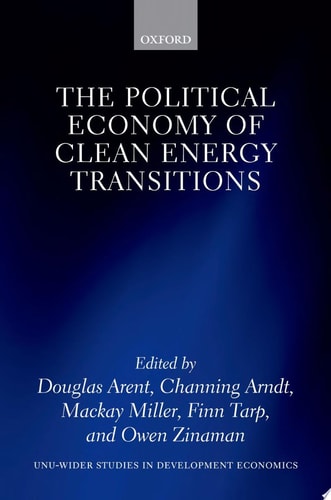
The Political Economy of Clean Energy Transitions
0
0
As an Amazon Associate and affiliate partner, Menrva Books earns from qualifying purchases. Learn more
Author Description
The 21st Conference of the Parties (CoP21) to the United Nations Framework Convention on Climate Change (UNFCCC) shifted the nature of the political economy challenge associated with achieving a global emissions trajectory that is consistent with a stable climate. The shifts generated by CoP21 place country decision-making and country policies at centre stage. Under moderately optimistic assumptions concerning the vigour with which CoP21 objectives are pursued, nearly every country will attempt to design and implement the most promising and locally relevant policies for achieving their agreed contribution to global mitigation. These policies will vary dramatically across countries as they embark on an unprecedented era of policy experimentation in driving a clean energy transition.This book steps into this new world of broad-scale and locally relevant policy experimentation. The chapters focus on the political economy of clean energy transition with an emphasis on specific issues encountered in both developed and developing countries. The authors contribute a broad diversity of experience drawn from all major regions of the world, representing a compendium of what has been learned from recent initiatives, mostly (but not exclusively) at country level, to reduce GHG emissions. As this new era of experimentation dawns, their contributions are both relevant and timely.
Menrva's Summary
THE THESIS
This book investigates how the post-CoP21 global climate landscape necessitates a shift toward localized, country-specific policy experimentation to achieve meaningful emissions reductions. The authors, a team of international experts and economists, synthesize diverse regional experiences to analyze the political and economic barriers inherent in transitioning to clean energy. By examining both developed and developing nations, the text provides a framework for understanding how national decision-making processes influence the success of global mitigation strategies.
THE SCOPE MAP
What You Will Find
- Comparative analysis of energy policy frameworks across diverse global regions.
- Examination of the political economy challenges unique to both developed and developing economies.
- Case studies detailing recent national initiatives to reduce greenhouse gas emissions.
- Methodological insights into designing locally relevant climate policies.
THE AUTHORITY PERSPECTIVE
Experts identify this volume as a critical resource for policymakers and researchers navigating the complexities of international climate agreements. Readers frequently note the academic density of the prose, which serves as a foundational text for understanding the intersection of national policy and global energy transitions.
Page Count:
544
Publication Date:
2017-06-13
Publisher:
Oxford University Press
ISBN-10:
0198802242
ISBN-13:
9780198802242
Economics
Sustainability
Climate Change
Energy policy
Energy
Community Tags
Similar Books