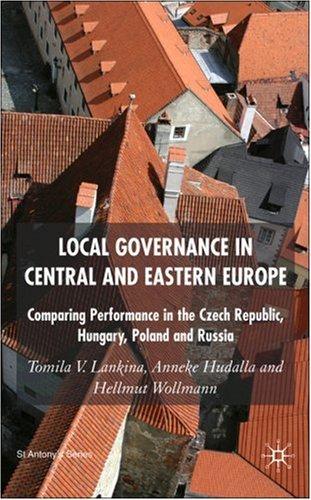
Local Governance in Central and Eastern Europe
0
0
As an Amazon Associate and affiliate partner, Menrva Books earns from qualifying purchases. Learn more
Author Description
After decades of central planning, decentralization has been made a centrepiece of political reforms in post-communist states. Despite all the normative hype and rhetoric, we still know very little about the impact of decentralization on local populations. This study, which examines local social services and economic promotion in the Czech Republic, Hungary, Poland and Russia, fills this important gap. It shifts the focus of much of the literature on post-communism from national-level actors to those at the level of small-to-medium-sized cities. At this level too, institutional choices matter, politics can be messy, and much depends on the ability of local actors themselves, rather than their national governments, to seize opportunities for change and development. The study dispels the myth that socio-economic 'givens' or inter-governmental systems are key determinants of local outcomes: instead, it shows how party political factors and local civic activism can and do make a difference, and should be given greater prominence in the literature on local performance.
Menrva's Summary
THE THESIS
This study investigates the impact of decentralization on local governance and social services in post-communist Central and Eastern European cities. Hellmut Wollmann examines the reforms in the Czech Republic, Hungary, Poland, and Russia, shifting the focus from national-level actors to those in small-to-medium-sized cities. The research highlights that institutional choices, local politics, and the agency of local actors are crucial for change and development, rather than solely relying on inter-governmental systems or socio-economic conditions. It argues for greater emphasis on party political factors and local civic activism in understanding local performance.
THE SCOPE MAP
- Analysis of decentralization reforms in post-communist states.
- Case studies of local social services and economic promotion in the Czech Republic, Hungary, Poland, and Russia.
- Focus on small-to-medium-sized cities as units of analysis.
- Examination of the role of institutional choices and local politics.
- Assessment of the impact of local actors' abilities to drive change.
- Investigation into the influence of party political factors on local outcomes.
- Exploration of the significance of local civic activism.
THE AUTHORITY PERSPECTIVE
The book addresses a significant gap in the literature by examining the practical impact of decentralization on local populations in post-communist states, moving beyond national-level analyses. It challenges the notion that socio-economic factors or inter-governmental systems are the primary determinants of local outcomes. Instead, the study emphasizes the critical roles of local politics, party dynamics, and civic activism in shaping local development and performance. This approach offers a more nuanced understanding of governance in Central and Eastern European cities.
Page Count:
272
Publication Date:
2008-01-01
ISBN-10:
0230500366
ISBN-13:
9780230500365
Politics
Non-Fiction
Urban Studies
Public Administration
Community Tags
Similar Books