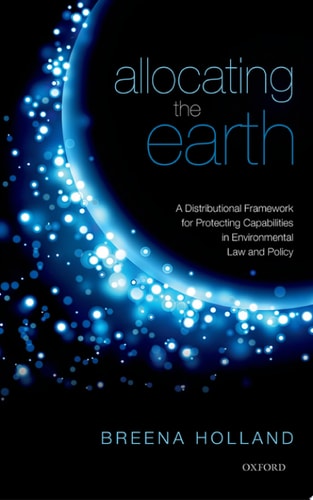
Allocating the Earth: A Distributional Framework for Protecting Capabilities in Environmental Law and Policy
0
0
As an Amazon Associate and affiliate partner, Menrva Books earns from qualifying purchases. Learn more
Author Description
This book advances a new distributional framework to guide the evaluation and design of environmental policies. Drawing on capabilities theory, especially as articulated in Martha Nussbaum's capabilities approach to justice, the book proposes that environmental policies should aim to secure the basic capabilities that make it possible for people to live a flourishing and dignified human life. Holland begins by establishing protection of the natural environment as central to securing these capabilities and then considers the implications for debates in environmental valuation, policy justification, and administrative rulemaking. In each of these areas, she demonstrates how a 'capabilities approach to social and environmental justice' can minimize substantive and procedural inequities that result from how we evaluate and design environmental policies in contemporary society. Holland's proposals include valuing environmental goods and services as comparable - but not commensurable - across the same dimension of well-being of different people, justifying environmental policies with respect to both the capability thresholds they secure and the capability ceilings they establish, and subjecting the outcomes of participatory decisions in the administrative rulemaking process to stronger substantive standards. In developing and applying this unique approach to justice, Holland primarily focuses on questions of domestic environmental policy. In the closing chapter she turns to theoretical debates about international climate policy and sketches how her approach to justice could inform both the philosophical grounding and practical application of efforts to achieve global climate justice. Engaging current debates in environmental policy and political theory, the book is a sustained exercise of both applied and environmental political theory.
Menrva's Summary
THE THESIS
This book investigates how a distributional framework based on capabilities theory can improve the evaluation and design of environmental policies to ensure human flourishing. Breena Holland, a scholar in political theory, utilizes Martha Nussbaum’s capabilities approach to argue that environmental protection is a prerequisite for securing the basic conditions of a dignified life. By applying this framework to environmental valuation, policy justification, and administrative rulemaking, the author provides a systematic method for addressing substantive and procedural inequities in current policy structures.
THE SCOPE MAP
What You Will Find
- A capabilities-based framework for environmental justice
- Methodologies for valuing environmental goods as comparable but not commensurable
- Proposals for establishing capability thresholds and ceilings in policy design
- Theoretical applications for domestic and international climate policy
Scope Limits
- The primary focus is on domestic environmental policy, with only a brief extension into global climate justice
- The text does not provide a comprehensive technical manual for specific ecological engineering or scientific mitigation strategies
THE AUTHORITY PERSPECTIVE
Scholars and practitioners in environmental law and political theory recognize this work as a significant contribution to the intersection of justice theory and policy design. Readers frequently note the academic density of the prose, which is intended for an audience familiar with philosophical discourse and administrative law.
Page Count:
272
Publication Date:
2014-01-01
Publisher:
OUP Oxford
ISBN-10:
0191034444
ISBN-13:
9780191034442
Politics
Philosophy
Kindle Store
Categories
Public Administration
United States
Political Theory
Economic Policy & Development
Public Policy
Environment
Kindle eBooks
Social justice
Community Tags
Similar Books