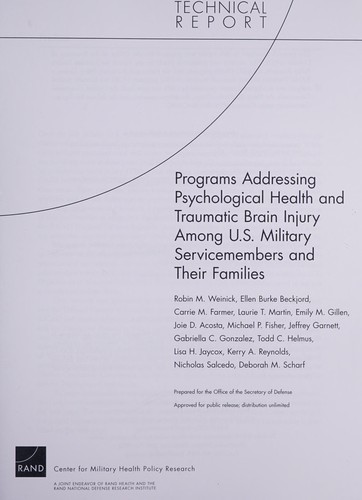
Programs Addressing Psychological Health and Traumatic Brain Injury Among U.S. Military Servicemembers and Their Families
0
0
As an Amazon Associate and affiliate partner, Menrva Books earns from qualifying purchases. Learn more
Author Description
Over the last decade, U.S. military forces have been engaged in extended conflicts that are characterized by increased operational tempo, most notably in Iraq and Afghanistan. While most military personnel cope well across the deployment cycle, many will experience difficulties handling stress at some point; will face psychological health challenges, such as post-traumatic stress disorder or major depression; or will be affected by the short- and long-term psychological and cognitive consequences of a traumatic brain injury (TBI). Over the past several years, the Department of Defense (DoD) has implemented numerous programs that address various components of psychological health along the resilience, prevention, and treatment continuum and focus on a variety of clinical and nonclinical concerns.^ This comprehensive catalog of programs currently sponsored or funded by DoD to address psychological health and TBI provides overviews and detailed descriptions of 211 programs, along with a description of how programs relate to other available resources and care settings. It also provides recommendations for clarifying the role of programs, examining gaps in routine service delivery that could be filled by programs, and reducing implementation barriers. Barriers include inadequate funding and resources, concerns about the stigma associated with receiving psychological health services, and inability to have servicemembers spend adequate time in programs. The authors found that there is significant duplication of effort, both within and across branches of service. As each program develops its methods independently, it is difficult to determine which approaches work and which are ineffective.^ Recommendations include strategic planning, centralized coordination, and information-sharing across branches of service, combined with rigorous evaluation. Programs should be evaluated and tracked in a database, and evidence-based interventions should be used to support program effor
Menrva's Summary
THE THESIS
This book investigates the landscape of psychological health and traumatic brain injury (TBI) programs within the U.S. military. It provides a comprehensive catalog of 211 programs sponsored or funded by the Department of Defense (DoD), detailing their overviews, specific functions, and relationships to other resources. The work identifies significant duplication of efforts across branches of service and highlights barriers to implementation such as funding, stigma, and time constraints.
THE SCOPE MAP
- Overviews and detailed descriptions of 211 DoD-sponsored or funded programs addressing psychological health and TBI.
- Analysis of how these programs relate to other available resources and care settings.
- Identification of gaps in routine service delivery that could be addressed by existing or new programs.
- Recommendations for clarifying program roles, reducing implementation barriers (stigma, funding, time), and addressing duplication of effort.
- Discussion of the need for strategic planning, centralized coordination, and information-sharing across military branches.
- Emphasis on the importance of rigorous program evaluation and the use of evidence-based interventions, tracked in a database.
THE AUTHORITY PERSPECTIVE
This report offers a critical assessment of the U.S. Department of Defense's efforts in addressing psychological health and TBI among servicemembers and their families. The authors identify significant redundancies and implementation challenges, suggesting a need for greater coordination and evaluation. The work provides actionable recommendations for improving program effectiveness and resource allocation within the military healthcare system. Its findings are likely to be of interest to policymakers, military health professionals, and researchers focused on military mental health.
Page Count:
148
Publication Date:
2011-01-01
ISBN-10:
0833052365
ISBN-13:
9780833052360
Psychology
Health
Non-Fiction
Mental Health
Military
Community Tags
Similar Books














Reader Comments
Share Your Thoughts
No comments yet. Be the first to share your thoughts!