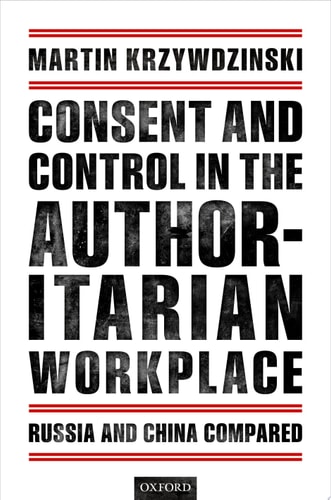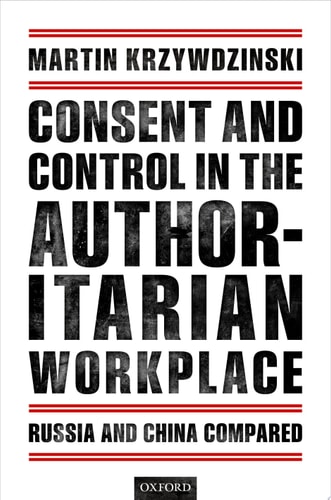
Consent and Control in the Authoritarian Workplace: Russia and China Compared
0
0
As an Amazon Associate and affiliate partner, Menrva Books earns from qualifying purchases. Learn more
Author Description
Today, a large proportion of the world's states are under authoritarian governments. These countries limit participation rights, both in the political sphere and in the workplace. At the same time, they have to generate consent in the workplace in order to ensure social stability and prevent the escalation of conflicts. But how do companies generate consent given that employee voice and interest representation may be limited or entirely absent?Based on a review of research literature from sociology, organizational psychology, and behavioural economics, this book develops a theory of consent generation and distinguishes three groups of consent-producing mechanisms: socialization, incentive mechanisms, and participation and interest representation. It presents an empirical analysis of how these mechanisms work in Russian and Chinese automotive factories and shows how socio-cultural factors and labour regulation explain the differences between both countries regarding consent and control in the workplace.The book contributes to two research debates. First, it examines the generation of consent in the workplace-a core topic of the sociology of work and organization. Its particular focus is on consent generation in authoritarian societies. Secondly, the book contributes to the debate about the reasons for the completely different trajectories of post-communist Russia and China. The book provides an empirical analysis that explains the different work behaviours of employees in both countries and links the micro-level of the workplace and the macro-level of institutions and organizational cultures.
Menrva's Summary
THE THESIS
This book investigates how companies operating within authoritarian political systems generate employee consent and maintain workplace stability in the absence of robust democratic participation rights. Author Martin Krzywdzinski synthesizes research from sociology, organizational psychology, and behavioral economics to construct a theoretical framework for understanding consent-producing mechanisms. By applying this framework to the automotive industries of Russia and China, the author analyzes how distinct socio-cultural environments and labor regulations shape the management of workforce behavior and institutional control.
THE SCOPE MAP
What You Will Find
- A theoretical model categorizing consent mechanisms into socialization, incentive structures, and interest representation.
- Comparative empirical analysis of automotive manufacturing plants in Russia and China.
- Examination of the intersection between micro-level workplace dynamics and macro-level institutional environments.
- Analysis of how post-communist trajectories influence contemporary labor relations and employee behavior.
THE AUTHORITY PERSPECTIVE
Scholars in the fields of industrial relations and comparative politics view this work as a significant contribution to the understanding of labor management in non-democratic regimes. Readers frequently note the academic rigor of the comparative methodology and the clarity with which the author bridges the gap between organizational theory and political science.
Page Count:
320
Publication Date:
2018-04-22
Publisher:
Oxford University Press
ISBN-10:
0198806485
ISBN-13:
9780198806486
Economics
Industrial Relations
Russia
Labor Studies
Sociology
China
Industries russia federation
Community Tags
Similar Books