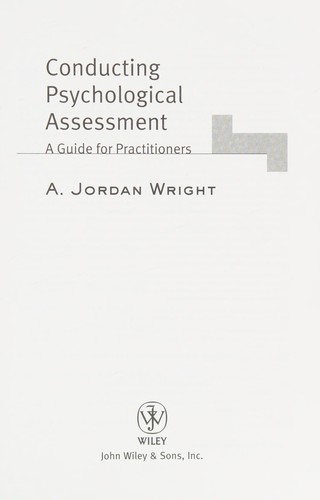
Conducting Psychological Assessments
0
0
As an Amazon Associate and affiliate partner, Menrva Books earns from qualifying purchases. Learn more
Author Description
The major market need for this book comes from the fact that the bulk of the literature on psychological assessment focuses on individual tests, rather than the process of using tests as part of an overall integrative assessment process. The author has taught many Ph.D. students psychological assessment and supervised students taught by other professors, and it is clear to him that while interpretation of individual tests is relatively consistent, the basic foundations of how to use test data and how to integrate them into coherent and useful narratives varies greatly from assessor to assessor depending on their training. Many students and psychologists focus so much on adequate administration, scoring, and interpretation of individual tests that little attention is paid to the integration, conceptualization, and write-up phases of the process. This book provides concrete examples to illustrate how to navigate this process, which is too often left to chance.
Menrva's Summary
THE THESIS
This book addresses the critical gap in psychological assessment literature by focusing on the integrative process rather than individual tests. The author, drawing on extensive teaching and supervision experience, identifies a significant variation in how psychologists integrate test data into coherent narratives. While administration and scoring of individual tests are often consistent, the conceptualization and write-up phases are frequently underdeveloped, leading to inconsistent and less useful assessments. This text provides concrete examples and a structured approach to bridge this gap, emphasizing the importance of the holistic assessment process.
THE SCOPE MAP
- Focus on the integrative psychological assessment process.
- Guidance on using test data and integrating them into coherent narratives.
- Concrete examples illustrating the assessment process.
- Emphasis on conceptualization and write-up phases of assessment.
- Addresses the need for a standardized approach to psychological assessment integration.
THE AUTHORITY PERSPECTIVE
The book is designed to fill a recognized gap in the literature by providing practical guidance on the integrative aspects of psychological assessment. It targets students and practicing psychologists who may be proficient in individual test administration but lack a cohesive framework for synthesizing findings. The author's approach emphasizes the importance of conceptualization and narrative construction in assessment reports, suggesting a focus on practical application and skill development for the reader.
Page Count:
500
Publication Date:
2011-01-01
ISBN-10:
0470536756
ISBN-13:
9780470536759
Psychology
Non-Fiction
Assessment
Community Tags
Similar Books