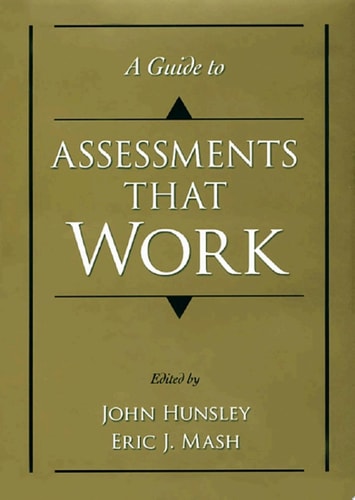
A Guide to Assessments That Work
0
0
As an Amazon Associate and affiliate partner, Menrva Books earns from qualifying purchases. Learn more
Author Description
The need for evidence-based practice in mental health services is becoming clearer by the day and, until recently, the trend of emphasizing services with supporting empirical evidence has been almost exclusively limited to a focus on treatment options. A Guide to Assessments That Work fills a void in the professional literature by addressing the critical role that assessment plays in providing evidence-based mental health services. To optimize its usefulness to readers, this volume addresses the assessment of the most commonly encountered disorders or conditions among children, adolescents, adults, older adults, and couples. Strategies and instruments for assessing mood disorders, anxiety disorders, couple distress and sexual problems, health-related problems, and many other conditions are also covered in depth. With a focus throughout on assessment instruments that are feasible, psychometrically sound, and useful for typical clinical requirements, a rating system has been designed to provide evaluations of a measure's norms, reliability, validity, and clinical utility. Standardized tables summarize this information in each chapter, providing essential information on the most scientifically sound tools available for a range of assessment needs. Using the tools provided in A Guide to Assessments That Work, readers can at a glance determine the possible suitability and value of each instrument for their own clinical purposes. This much needed resource equips readers with the knowledge necessary for conducting the best evidence-based mental health assessments currently possible.
Menrva's Summary
THE THESIS
This volume addresses the critical need for evidence-based assessment practices within mental health services by evaluating the scientific validity and clinical utility of common diagnostic instruments. Authors Eric J. Mash and John Hunsley, both established experts in clinical psychology, curate a comprehensive framework that shifts the focus from treatment-only evidence to the diagnostic tools that inform clinical decision-making. The text provides a systematic rating system to help practitioners identify instruments that are psychometrically sound and feasible for diverse populations.
THE SCOPE MAP
What You Will Find
- A standardized rating system for evaluating norms, reliability, validity, and clinical utility.
- Coverage of assessment strategies for mood disorders, anxiety, couple distress, and health-related conditions.
- Standardized summary tables for quick reference of instrument suitability.
- Guidance for assessing children, adolescents, adults, and older adults.
Scope Limits
- The text focuses primarily on established, empirically supported instruments rather than experimental or emerging diagnostic technologies.
- It does not provide exhaustive coverage of every niche psychological condition or rare disorder.
THE AUTHORITY PERSPECTIVE
Experts and practitioners frequently cite this volume as a foundational resource for integrating empirical rigor into clinical assessment workflows. Readers often note the high density of technical information, which makes it a practical reference tool for clinicians and students alike.
Page Count:
696
Publication Date:
2008-01-01
Publisher:
Oxford University Press
ISBN-10:
0190295074
ISBN-13:
9780190295073
Psychology
Evidence-Based Practice
Assessment
Mental Illness
Allied Health
Mental Health
Medical
Professional Reference
Community Tags
Other Editions(5)


Similar Books



Reader Comments
Share Your Thoughts
No comments yet. Be the first to share your thoughts!