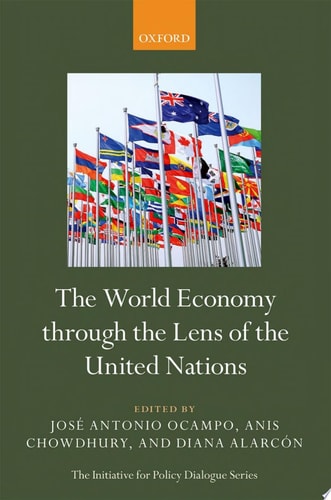
The World Economy through the Lens of the United Nations
0
0
As an Amazon Associate and affiliate partner, Menrva Books earns from qualifying purchases. Learn more
Author Description
This edited volume documents the intellectual influence of the United Nations Department of Economic and Social Affairs (UN-DESA) through its flagship publication, the World Economic and Social Survey (WESS) on its 70th Anniversary.First published in 1948, as World Economic Report, WESS is the oldest continuous post-World War II publication recording and analysing the performance of the global economy and social development trends. It offers relevant policy recommendations and highlights how well the United Nation's (UN) annual report has tracked global economic and social conditions, and how its analyses influenced and were influenced by the prevailing development discourse during the past seven decades. It also critically reflects on its policy recommendations and their influence on actual policy-making and the shaping of the world economy. The World Economy through the Lens of the United Nations reflects on this report, amongst others, to provide valuable insights on global economic challenges and their differential impacts on different groups of countries requiring global policy coordination as well as context specific policy responses. It demonstrates that UN reports have often been ahead of the curve and played a critical role in policy debate, especially in the area of international policy coordination and coherence for balanced global development, and offers rich and path-breaking analyses of contemporary problems of growth, development, trade and stabilization.
Menrva's Summary
THE THESIS
This volume investigates the historical and intellectual impact of the United Nations Department of Economic and Social Affairs (UN-DESA) through its flagship publication, the World Economic and Social Survey (WESS), over its seventy-year history. The authors, including José Antonio Ocampo, utilize the WESS archives to evaluate how the United Nations has tracked global economic trends and influenced international development discourse. By examining the evolution of these reports since 1948, the text provides a critical assessment of how UN policy recommendations have shaped global economic stabilization and trade strategies. The work serves as a retrospective analysis of the organization's role in fostering international policy coordination and coherence.
THE SCOPE MAP
What You Will Find
- A comprehensive historical review of the World Economic and Social Survey from 1948 to the present.
- Analysis of the interplay between UN economic reporting and prevailing global development paradigms.
- Case studies on the differential impacts of global economic challenges across varying country groups.
- Evaluations of the effectiveness of UN policy recommendations in shaping actual national and international economic governance.
THE AUTHORITY PERSPECTIVE
Experts identify this volume as a significant contribution to the history of international economic thought and institutional policy analysis. Readers frequently note the academic density of the prose, which serves as a valuable resource for scholars and policymakers interested in the evolution of global development frameworks.
Page Count:
336
Publication Date:
2018-05-22
Publisher:
Oxford University Press
ISBN-10:
0198817347
ISBN-13:
9780198817345
Economics
History
Public Policy
United Nations
International relations
Developing Countries
Community Tags
Similar Books