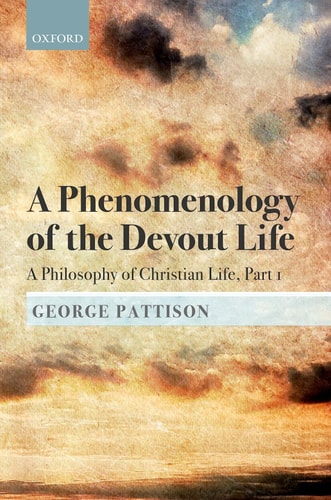
A Phenomenology of the Devout Life: A Philosophy of Christian Life, Part I
0
0
As an Amazon Associate and affiliate partner, Menrva Books earns from qualifying purchases. Learn more
Author Description
A Phenomenology of the Devout Life is the first part of a three-part work, A Philosophy of Christian Life. Rather than approaching Christianity through its doctrinal statements, as philosophers of religion have often done, the book starts by offering a phenomenological description of the devout life as that is set out in the teaching of Francois de Sales and related authors. This is because for most Christians practice and life-commitments are more fundamental than formal doctrinal beliefs. Although George Pattison will address the metaphysical truth-claims of Christianity in Part three, the guiding argument is that it is the Christian way of life that best reveals what these beliefs really are. As the work is a philosophical study, it does not presuppose the truth of Christianity but assumes only that there is a humanly accessible meaning to the intention to live a devout life, pleasing to God. This can be said to find expression in a certain view of selfhood that emphasizes the dimensions of feeling and will rather than intellect and that culminates in the experience of the annihilation of self. This is a model of selfhood deeply opposed to contemporary models that privilege autonomous agency and the devout life is therefore presented as offering a corrective to extreme versions of the contemporary view.
Menrva's Summary
THE THESIS
This work investigates whether the lived experience of Christian devotion offers a more fundamental insight into the nature of faith than traditional doctrinal analysis. George Pattison, a scholar of modern religious thought, shifts the focus from abstract metaphysical propositions to the practical, lived reality of the devout life. By utilizing the teachings of Francois de Sales, the author constructs a philosophical framework that prioritizes feeling and will over pure intellect. The central argument posits that the Christian way of life provides a distinct, humanly accessible meaning that challenges contemporary models of autonomous agency.
THE SCOPE MAP
What You Will Find
- A phenomenological analysis of the devout life as practiced in historical Christian traditions.
- A comparative study of selfhood, contrasting traditional devotion with modern autonomous agency.
- An examination of the role of feeling and will in the formation of religious identity.
- A foundational methodology for a three-part philosophical inquiry into Christian existence.
THE AUTHORITY PERSPECTIVE
Scholars and students of philosophy of religion frequently note the clarity with which Pattison navigates complex phenomenological concepts. Experts highlight this text as a significant contribution to the study of religious practice, particularly for its departure from purely doctrinal approaches to theology.
Page Count:
240
Publication Date:
2018-12-25
Publisher:
Oxford University Press
ISBN-10:
0198813503
ISBN-13:
9780198813507
Religion
Philosophy
Theology
Spiritual life
Christianity
Phenomenology
Community Tags
Similar Books