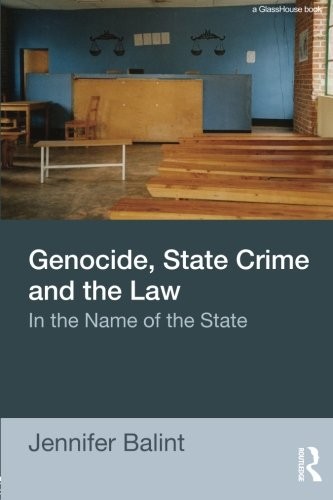
Genocide, State Crime and the Law
0
0
As an Amazon Associate and affiliate partner, Menrva Books earns from qualifying purchases. Learn more
Author Description
"Genocide, State Crime and the Law critically explores the use and role of law in the perpetration, redress and prevention of mass harm by the state. In this broad ranging book, Jennifer Balint charts the place of law in the perpetration of genocide and other crimes of the state together with its role in redress and in the process of reconstruction and reconciliation, considering law in its social and political context. The book argues for a new approach to these crimes perpetrated 'in the name of the state' - that we understand them as crimes against humanity with particular institutional dimensions that law must address to be effective in accountability and as a basis for restoration. Focusing on seven instances of state crime - the genocide of the Armenians by the Ottoman state, the Holocaust and Nazi Germany, Cambodia under the Khmer Rouge, apartheid South Africa, Ethiopia under Mengistu and the Dergue, the genocide in Rwanda, and the conflict in the former Yugoslavia - and drawing on others, the book shows how law is companion and collaborator in these acts of nation-building by the state, and the limits and potentials of law's constitutive role in post-conflict reconstruction. It considers how law can be a partner in destruction yet also provide a space for justice. An important, and indeed vital, contribution to the growing interest and literature in the area of genocide and post-conflict studies, Genocide, State Crime and the Law will be of considerable value to those concerned with law's ability to be a force for good in the wake of harm and atrocity."-- Publisher description.
Menrva's Summary
THE THESIS
This book investigates the complex and often contradictory role of law in state-sponsored mass atrocities. Jennifer Balint, a scholar in the field, examines how legal frameworks can both facilitate and attempt to redress genocide and other state crimes. The book analyzes seven specific historical instances, including the Armenian genocide, the Holocaust, Cambodia under the Khmer Rouge, apartheid South Africa, Ethiopia under Mengistu, Rwanda, and the former Yugoslavia, to understand law's complicity in nation-building through violence and its potential for accountability and restoration in post-conflict societies.
THE SCOPE MAP
- Analysis of law's role in the perpetration of state crimes and genocide.
- Examination of law's function in redress, reconstruction, and reconciliation.
- Case studies of seven major instances of state crime: Armenian genocide, Holocaust, Khmer Rouge, apartheid South Africa, Mengistu's Ethiopia, Rwanda, and former Yugoslavia.
- Exploration of the social and political contexts in which law operates during mass harm.
- Argument for understanding state crimes as crimes against humanity with specific institutional dimensions.
- Discussion of law's dual capacity as a partner in destruction and a space for justice.
THE AUTHORITY PERSPECTIVE
This book is recognized as a vital contribution to the study of genocide and post-conflict issues. It is valued for its critical exploration of how legal systems interact with state-perpetrated mass harm, offering insights into both complicity and potential for justice. The work is considered particularly useful for those interested in the capacity of law to act as a force for good following atrocities. Its comprehensive case studies and theoretical framework provide a nuanced understanding of law's complex role in historical and contemporary conflicts.
Page Count:
256
Publication Date:
2012-01-01
ISBN-10:
0415680271
ISBN-13:
9780415680271
Crime
Non-Fiction
History
Politics
Law
Sociology
Community Tags
Similar Books