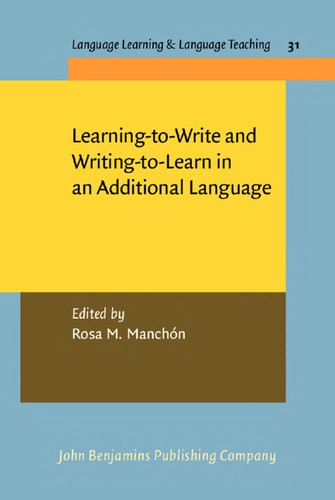
Learning-to-write and writing-to-learn in an additional language
0
0
As an Amazon Associate and affiliate partner, Menrva Books earns from qualifying purchases. Learn more
Author Description
This book is a pioneer attempt to bridge the gap between the fields of second language acquisition (SLA) and second and foreign language (L2) writing. Its ultimate aim is to advance our understanding of written language learning by compiling a collection of theoretical meta-reflections and empirical studies that shed new light on two crucial dimensions of the theory and research in the field: first, the manner in which L2 users learn to express themselves in writing (the learning-to-write dimension), and, second, the manner in which the engagement in written output practice can contribute to developing competences in an L2 (the writing-to-learn dimension). These two areas of disciplinary inquiry have up until now developed separately: the learning-to-write dimension has been the cornerstone of L2 writing research, whereas the writing-to-learn one has been theorized and researched within SLA studies, hence the relevance of the book for exploring L2 writing-SLA interfaces. -- Book Description.
Menrva's Summary
THE THESIS
This book investigates the interconnectedness of learning to write and writing to learn in the context of additional languages. It aims to bridge the gap between Second Language Acquisition (SLA) and L2 writing research by presenting theoretical reflections and empirical studies. The work explores how individuals acquire the skills to express themselves in writing in a second language, and conversely, how the act of writing can enhance overall L2 competence. This interdisciplinary approach highlights the previously separate development of these two crucial dimensions within the field.
THE SCOPE MAP
- Theoretical meta-reflections on L2 writing and SLA.
- Empirical studies on the learning-to-write dimension.
- Empirical studies on the writing-to-learn dimension.
- Exploration of the interfaces between L2 writing research and SLA.
- Contributions to understanding written language learning in additional languages.
THE AUTHORITY PERSPECTIVE
This book is recognized as a significant contribution to the fields of Second Language Acquisition and L2 writing, offering a novel approach by integrating previously disparate areas of research. Its compilation of theoretical insights and empirical studies provides a comprehensive overview of the learning-to-write and writing-to-learn dimensions. The work is likely to be of interest to researchers and educators seeking to deepen their understanding of how learners develop written proficiency and how writing itself can foster language acquisition. The book's interdisciplinary focus is its key strength, offering a unified perspective on these critical aspects of language learning.
Page Count:
263
Publication Date:
2011-01-01
ISBN-10:
9027213038
ISBN-13:
9789027213037
Literary Fiction
Non-Fiction
Linguistics
Education
Community Tags
Similar Books