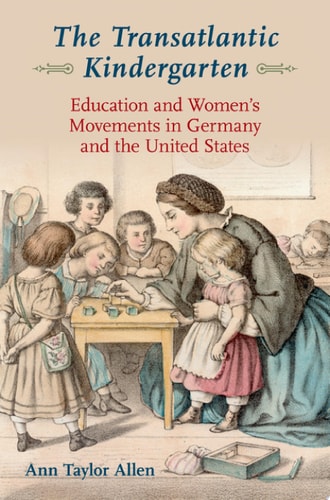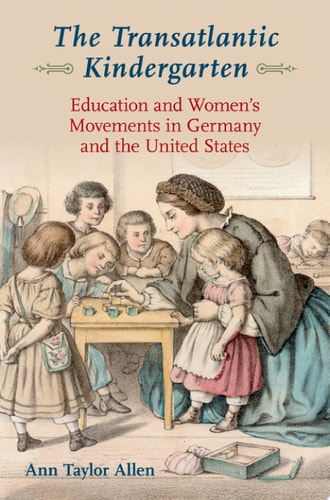
The Transatlantic Kindergarten: Education and Women's Movements in Germany and the United States
0
0
As an Amazon Associate and affiliate partner, Menrva Books earns from qualifying purchases. Learn more
Author Description
The kindergarten--as institution, as educational philosophy, and as social reform movement--is one of Germany's most important contributions to the world. Swiss pedagogue Johann Heinrich Pestalozzi and his German student Friedrich Fröbel, who founded the kindergarten movement around 1840, envisioned kindergartens as places of education and creative engagement for children across all classes, not merely as daycare centers for poor families. At first, however, Germany proved an inhospitable environment for this new institution. After the failure of the 1848 revolutions, several German governments banned the kindergarten as a hotbed of subversion because of its links to women's rights movements. German revolutionaries who were forced into exile introduced the kindergarten to the United States, where it soon found roots among native-born as well as immigrant educators.In an era when convention limited middle-class women to the domestic sphere, the kindergarten provided them with a rare opportunity not only for professional work, but also for involvement in social reform in the fields of education and child welfare. Through three generations, American and German women established many kinds of contactsIn this elegant book, Ann Taylor Allen presents the first transnational history of the kindergarten as it developed in Germany and the United States between 1840 and World War I. Based on a large body of previously untapped sources in bothcountries, The Transatlantic Kindergarten shows how a common body of ideas and practices adapted over time to two very different political and social environments. Since the end of the First World War, early childhood education in the United States and Germany has followed the patterns laid down in the nineteenth century. However, as Allen's nuanced analysis suggests, the provision of public preschool education is still an unfinished and much discussed project on both sides of the Atlantic.
Menrva's Summary
THE THESIS
This work investigates the transnational development of the kindergarten movement, examining how educational philosophies and social reform goals intersected with women's rights in Germany and the United States between 1840 and World War I. Ann Taylor Allen, a historian specializing in German and women's history, utilizes a vast collection of primary sources to analyze the movement's evolution. She argues that the kindergarten served as a critical vehicle for women to enter the professional sphere and influence social policy, despite facing significant political opposition in its country of origin. The book demonstrates how these ideas were adapted to fit the distinct cultural and political landscapes of two nations.
THE SCOPE MAP
What You Will Find
- Historical analysis of the kindergarten movement from 1840 to 1914.
- Comparative study of educational policy in Germany and the United States.
- Examination of the intersection between early childhood education and the women's rights movement.
- Primary source research documenting the professionalization of female educators.
Scope Limits
- The study concludes at the onset of World War I and does not provide an exhaustive history of twentieth-century preschool developments.
- The analysis focuses primarily on the German and American contexts, excluding other international adoptions of the Fröbelian model.
THE AUTHORITY PERSPECTIVE
Scholars recognize this text as a definitive comparative study of nineteenth-century educational reform and gender history. Readers frequently note the academic rigor of the research and the clarity with which Allen connects pedagogical theory to broader social movements.
Page Count:
304
Publication Date:
2017-01-01
Publisher:
Oxford University Press
ISBN-10:
0190274433
ISBN-13:
9780190274436
History
Kindergarten
European History
Transatlantic History
American History
Social Reform
Education germany
Professional Career & Trade
Educational Foundations
Modern History
Special Topics
Education
Womens Studies
Community Tags
Similar Books