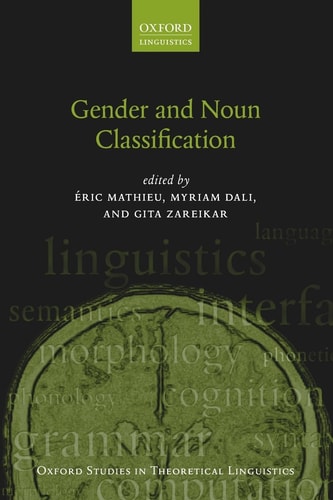
Gender and Noun Classification
0
0
As an Amazon Associate and affiliate partner, Menrva Books earns from qualifying purchases. Learn more
Author Description
This volume explores the many ways by which natural languages categorize nouns into genders or classes. A noun may belong to a given class because of its logical or symbolic similarities with other nouns, because it shares a similar morphological form with other nouns, or simply through an arbitrary convention. The aim of this book is to establish which functional or lexical categories are responsible for this type of classification, especially along the nominal syntactic spine.The book's contributors draw on data from a wide range of languages, including Amharic, French, Gitksan, Haro, Lithuanian, Japanese, Mi'kmaw, Persian, and Shona. Chapters examine where in the nominal structure gender is able to function as a classifying device, and how in the absence of gender, other functional elements in the nominal spine come to fill that gap. Other chapters focus on how gender participates in grammatical concord and agreement phenomena. The volume also discusses semantic agreement: hybrid agreement sometimes arises due to a distinction that grammars encode between natural gender on the one hand and grammatical gender on the other. The findings in the volume have significant implications for syntactic theory and theories of interpretation, and contribute to a greater understanding of the interplay between inflection and derivation. The volume will be of interest to theoretical linguists and typologists from advanced undergraduate level upwards.
Menrva's Summary
THE THESIS
This volume investigates the mechanisms by which natural languages categorize nouns into gender or class systems and the functional categories responsible for these classifications. The authors and contributors, including Gita Zareikar, Myriam Dali, and Éric Mathieu, utilize a comparative approach to analyze how nominal syntactic structures facilitate gender classification. By examining the interplay between inflection and derivation, the text provides a framework for understanding how languages manage grammatical concord and semantic agreement.
THE SCOPE MAP
What You Will Find
- Comparative analysis of noun classification across diverse languages including Amharic, French, Gitksan, and Japanese.
- Examination of the nominal syntactic spine and the role of functional categories in gender assignment.
- Discussion of hybrid agreement phenomena and the distinction between natural and grammatical gender.
- Theoretical implications for syntactic interpretation and the structural gaps filled by functional elements in the absence of gender.
THE AUTHORITY PERSPECTIVE
Experts identify this volume as a specialized resource for theoretical linguists and typologists focusing on nominal structure. Readers frequently note the academic density of the prose, which is intended for advanced undergraduate students and professional researchers in the field of linguistics.
Page Count:
336
Publication Date:
2019-01-15
Publisher:
Oxford University Press
ISBN-10:
019882811X
ISBN-13:
9780198828112
Reference
Academic
Linguistics
Syntax
Grammar
Community Tags
Similar Books